
Registry Record No. 7383 (Order No. 634 of the Ministry of Digital Development) • Rospatent No. 2019615805 • Rightsholder: UHSEP LLC
End-to-end automation of accident consequence modeling, potential, individual, and societal risk at hazardous production facilities in the oil, gas, and chemical sectors in accordance with national safety standards and international methodologies (TNO, AIChE/CCPS, IOGP, API).
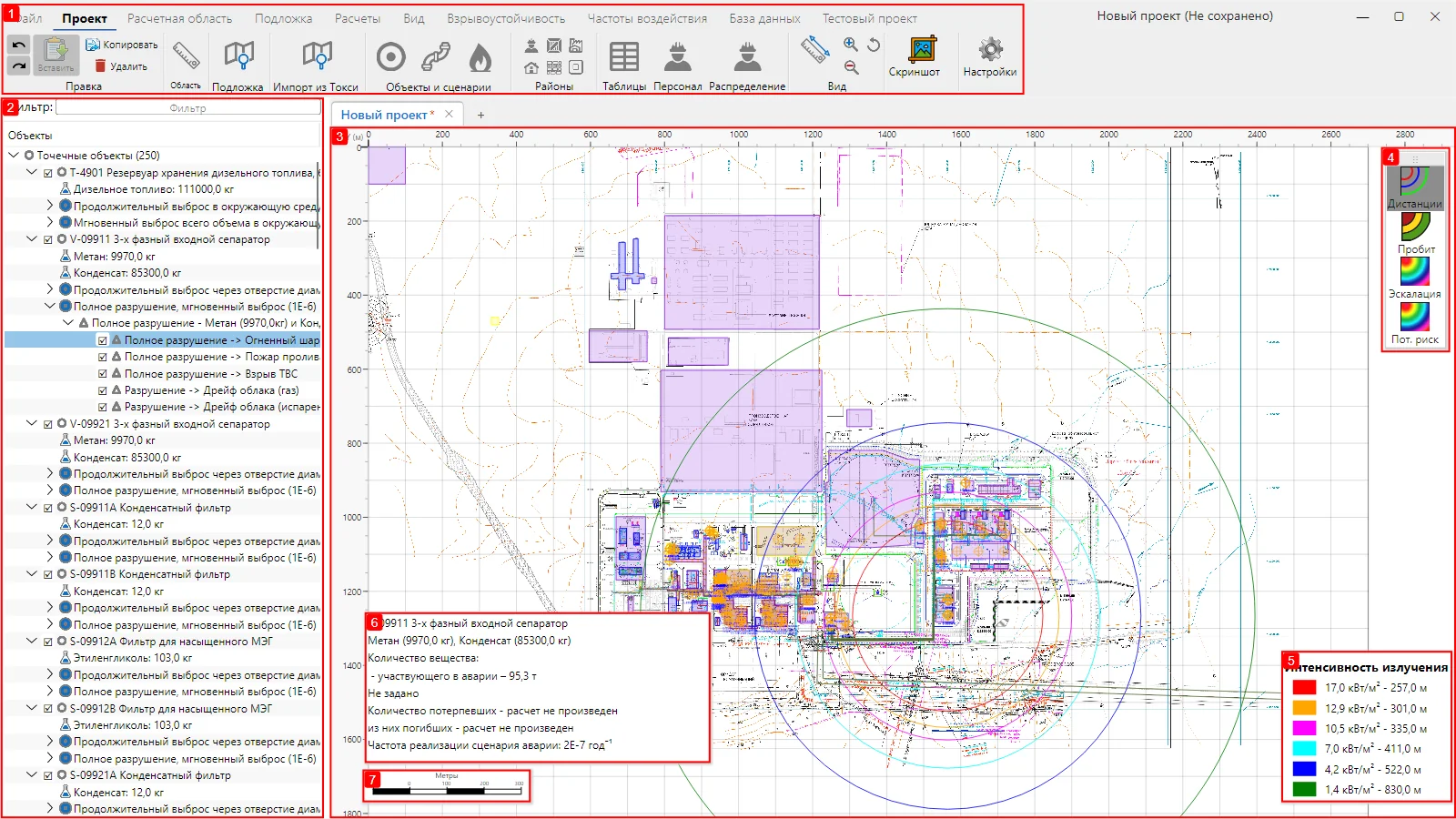
From facility plot plan ingestion and automated event tree construction to potential risk contours mapping and regulatory safety reporting.
Ingestion of raster and vector site plans of any resolution. Direct grabbing of high-res Google and Yandex satellite imagery with automatic coordinate georeferencing (WGS 84), site plans, and CAD drawings.
One-click placement of standard point and linear process equipment with preset characteristics, standard leak frequencies (RTH, EMERCOM, TNO, CCPS), event trees, and custom standalone incident scenarios.
High-fidelity simulation of all major accidental physical phenomena: discharge, flash evaporation, heavy gas dispersion, all fire regimes, blast overpressure waves, and missile projectile throw.
Computational grid evaluation of cumulative risk indicators accounting for weather roses, scenario event frequencies, and detailed spatio-temporal personnel distribution.
Simulation of secondary domino escalation triggered by thermal radiation from fire or blast wave and projectile fragment impact on neighbouring equipment.
Comprehensive calculation reports generation compliant with state regulatory safety audits and safety case requirements.
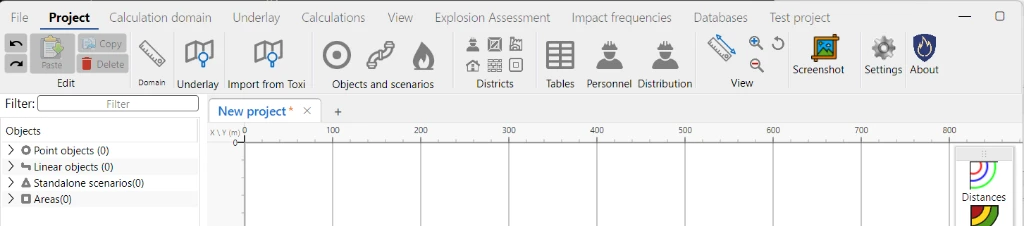
Full native bilingual support in Russian and English with instantaneous one-click language switching. All Ribbon commands, menus, process equipment hierarchy, databases, and configuration dialogs are fully localized for seamless teamwork across international engineering consortia and safety audits.

Risk Assessment 1.0 incorporates and verifies all current safety guidelines of Rostekhnadzor (2022–2023), EMERCOM of Russia methodologies, Gazprom industry standards, and international best practices.
Risk metrics evaluation, expected casualty/fatality counts, standard equipment accidental release frequencies, human and structure vulnerability criteria, cascade escalation risk to adjacent industrial sites.
Accident risk assessment methodology for refining and petrochemical facilities: failure scenarios of pressure vessels, pumping units, atmospheric storage tanks for flammable liquids.
Accident risk methodology for process pipelines transporting flammable gases: above-ground pipe racks, inter-unit transfer lines, discharge outflow, jet fire ignition.
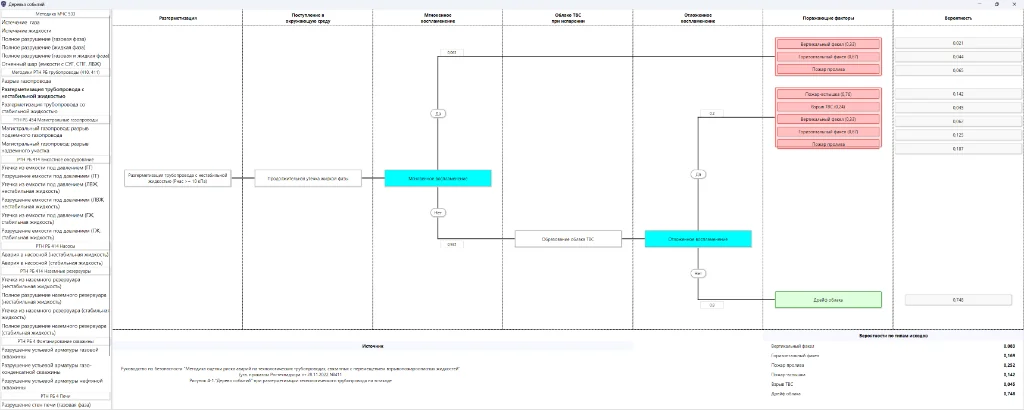
Risk assessment methodology for liquid process pipelines: pipe racks, stable combustible and unstable volatile liquids (LPG, condensates), spreading pools, and flash vaporization.
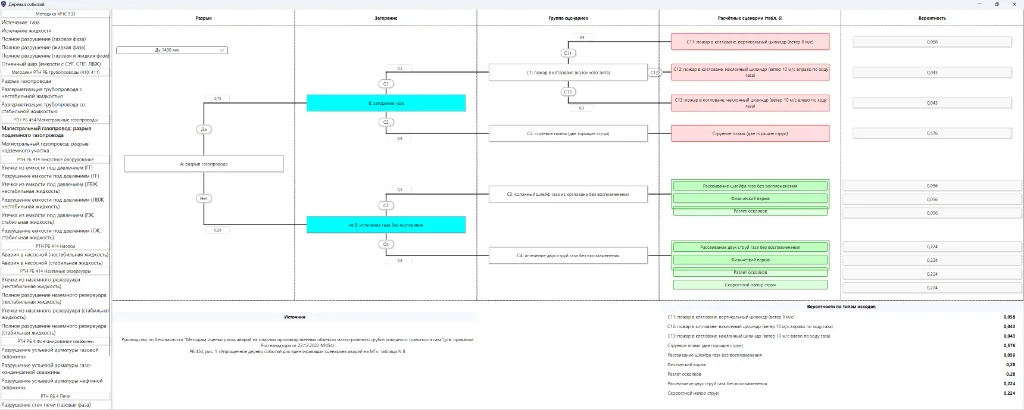
Risk assessment methodology for high-pressure gas transmission pipelines: full-bore ruptures of DN 1000–1420 mm pipes, transient decompression wave outflow, crater fires, supersonic jet flames, and missile throw.
Quantitative risk assessment guidelines for onshore and river-crossing pipeline sections, pump stations, and tank farm storage terminals.
Quantitative risk analysis guidelines for pipelines conveying broad fraction of light hydrocarbons (NGL) and stabilized/unpressurized gas condensates.
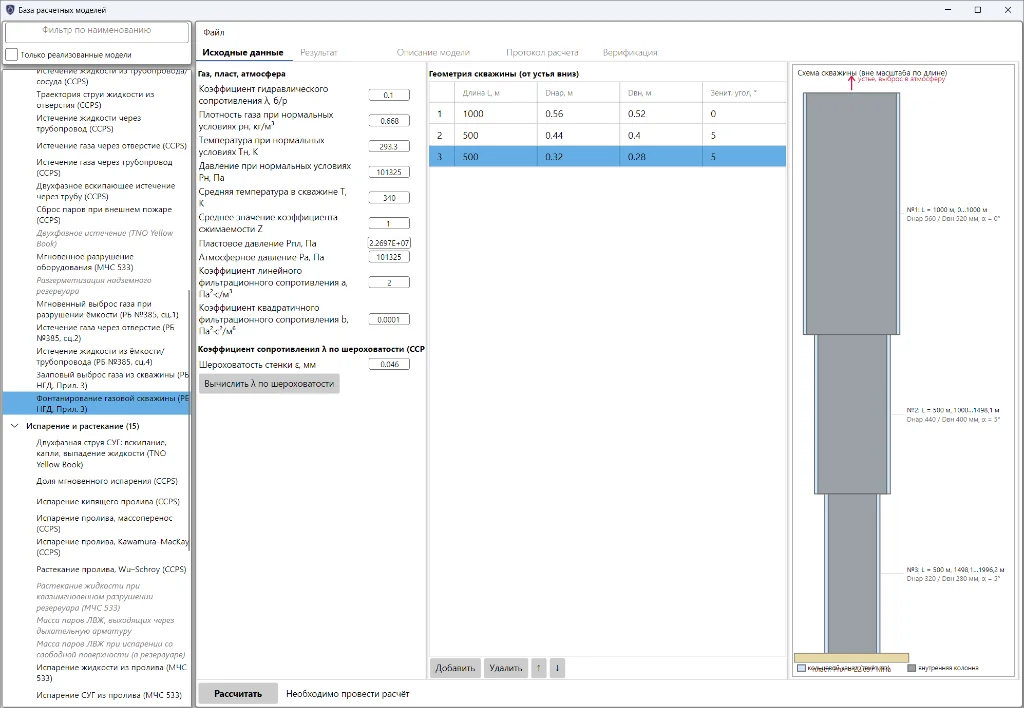
Wellhead blowout simulation of high-pressure gas and oil wells (reservoir inflow and wellbore multiphase dynamics), tube furnace coil failures.
Atmospheric boundary layer parameterization (Monin-Obukhov length, Pasquill stability classes), toxic and flammable gas dispersion, pool evaporation, benchmarked per Appendix 9.
Modern fire risk assessment methodology for industrial production facilities: Methods I–XIV of Appendix 4, outflow, evaporation, pool fires, jet fires, BLEVE fireballs, and VCE.
Worked numerical examples and official recommendations of VNIIPO EMERCOM of Russia: 100% benchmark verification of software algorithms resolving known standard misprints.
Process fire hazard appraisal methods: TNT-equivalent mass of VCE, blast overpressure and positive phase impulse, isentropic expansion energy for BLEVE, thermal radiation of pool fires.
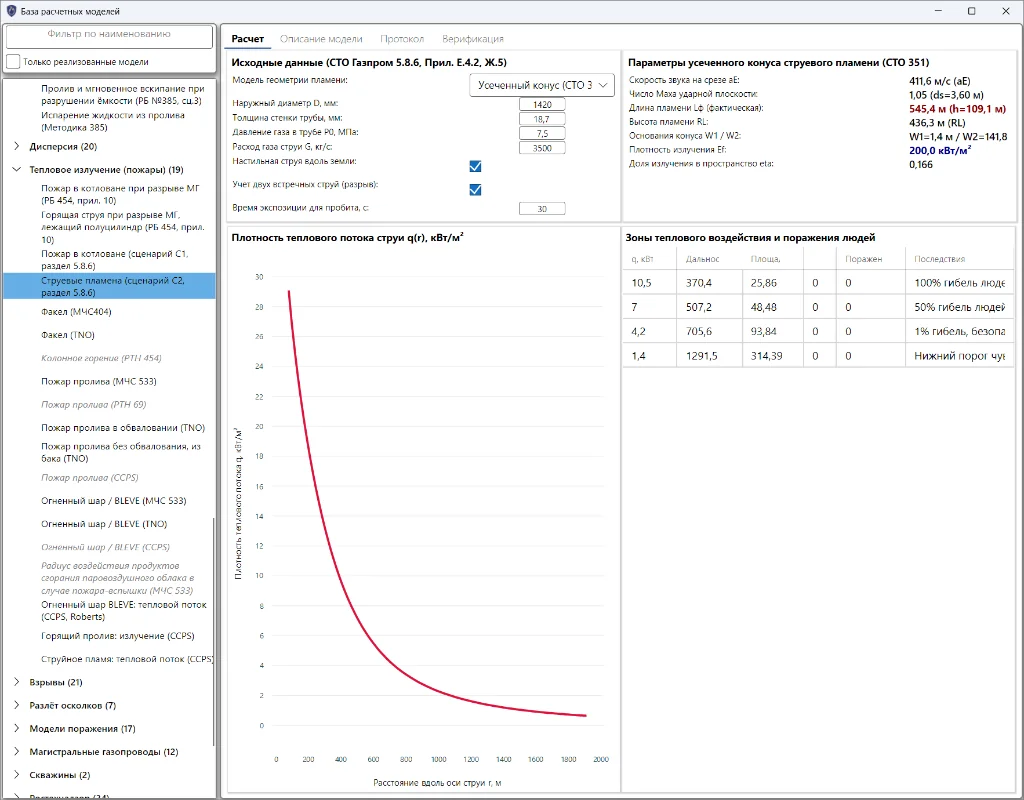
Sections 5.7, 5.8; Appendices D, E, F, G. Complete model suite: transient double-ended gas release from pipelines, Schlichting supersonic jet dispersion, crater fire, conical jet flame radiation, and projectile fragment ballistics.
Appendix C: transient blowout discharge calculations from production wells accounting for reservoir parameters (porosity, permeability, reservoir pressure) and choked flow dynamics.
European benchmark for QRA: standard event trees, calculations with discrete ignition sources (Method A) and free-field models (Method B), release frequencies for pressure vessels, atmospheric tanks, pipelines, pumps, heat exchangers, and road tankers.
33 physical effect calculation models: TNO Multi-Energy vapor cloud explosion, thermal radiation of BLEVE fireballs and flares, building damage zones appraisal.
Methods for determining impact damage to humans and assets: thermal radiation probits (fatality, burns, clothing ignition), blast wave impact (lungs, eardrums, body displacement, flying glass fragments), structural building collapse.
38 calculation models from the Center for Chemical Process Safety (AIChE): two-phase flashed discharge, multi-component pool vaporization, equipment reliability and failure probabilities.
Global benchmark for equipment leak frequencies and ignition probabilities: 24 equipment classes (434-01), well blowouts (434-02: drilling, HPHT, workover), tank storage & LNG (434-03), subsea pipelines & risers (434-04), 30 ignition event models (434-06).
Toxic exposure consequence appraisal per UK HSE methodology: toxic load calculation A = Cⁿ·t, SLOT (LD₁₋₅ fatality threshold) and SLOD (50% lethality LD₅₀) criteria, probit equations Pr = a + b·ln(Cⁿ·t) for hydrogen sulfide H₂S (n=4), ammonia, chlorine, SO₂, HF, and nitrogen oxides.
Centralized management of the project methodology baseline: one-click switching between regulatory model presets and automated assignment of leak frequencies for the facility equipment fleet.
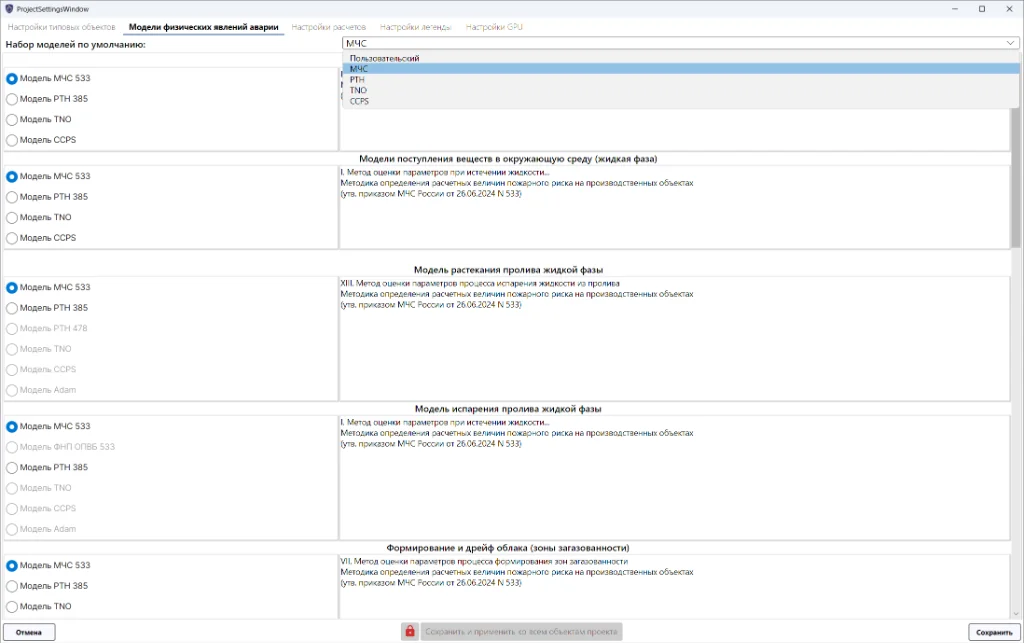
Instant 1-click model suite toggle: EMERCOM (Order No. 533), Rostekhnadzor (RB 385, 414, 478), TNO (Yellow / Purple Book), CCPS, or user-defined Custom baseline.
Modular algorithm selection for every stage: liquid discharge, gravity pool spreading, evaporation (EMERCOM 533 / RTH 385 / RTH 478 / Adam), VCE cloud formation and atmospheric drift.
The "Save and apply to all project objects" button synchronously updates calculation equations and parameter bounds across hundreds of units on the layout.
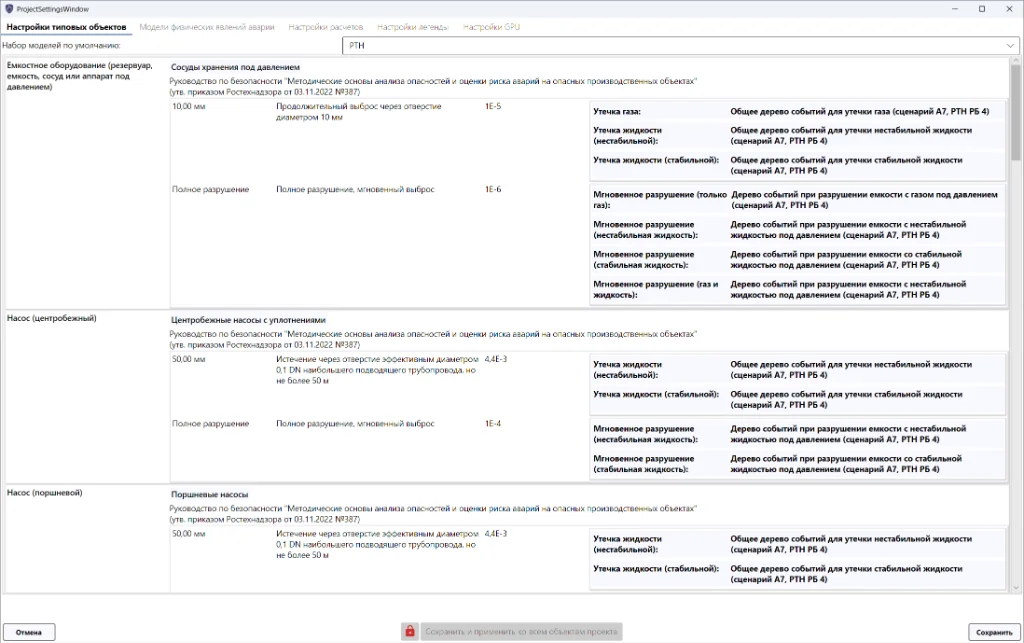
Default engineering parameters for pressure vessels, atmospheric tanks, pumps, compressors, heat exchangers, and wells per RTH RB 387 and international databases.
Rigorous scenario gradation: 10 mm pinhole leak ($10^{-5}$ yr⁻¹), 50 mm medium puncture ($4.4\cdot 10^{-3}$ yr⁻¹), full-bore rupture and catastrophic vessel burst ($10^{-4}$ to $10^{-6}$ yr⁻¹).
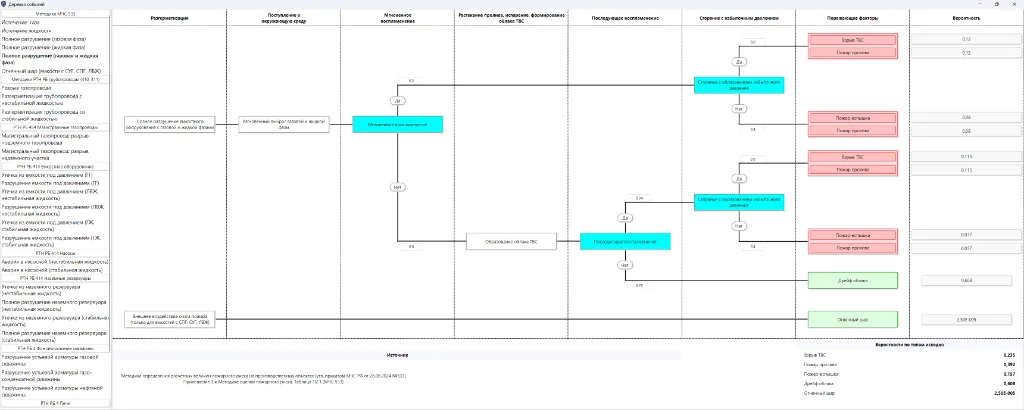
Each equipment line item is dynamically linked to its regulatory event tree: scenarios for compressed gas, stable/unstable liquids, and two-phase flashed releases.
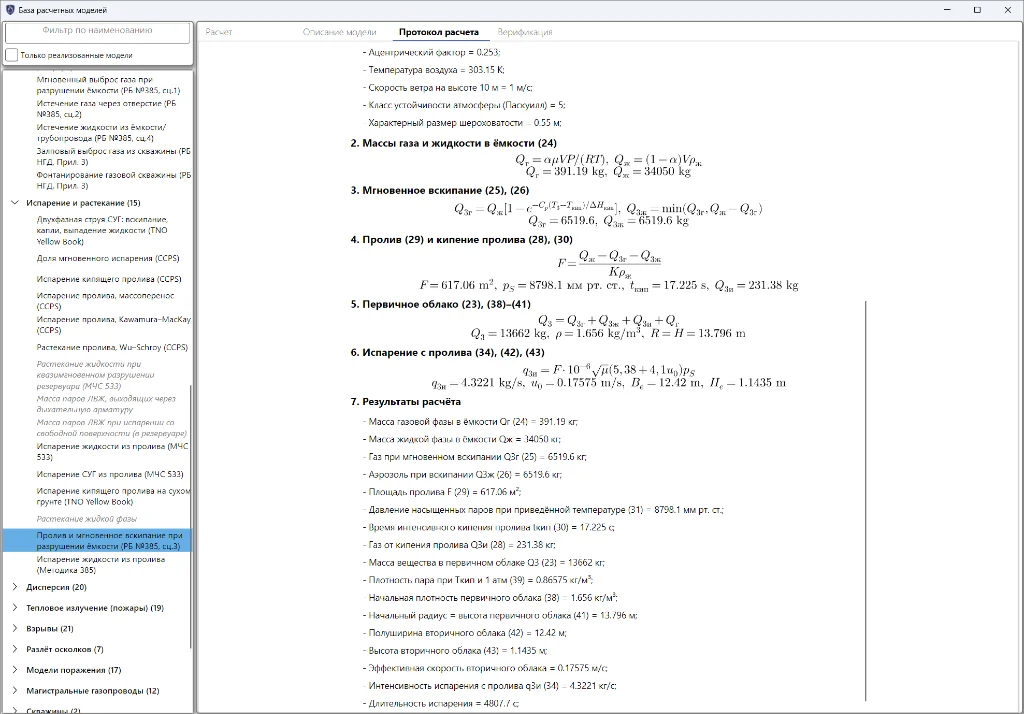
Built-in library of 33+ release models for compressed/liquefied gases, liquids, two-phase mixtures, and condensates with automated generation of detailed mathematical calculation protocols (LaTeX / MathML).
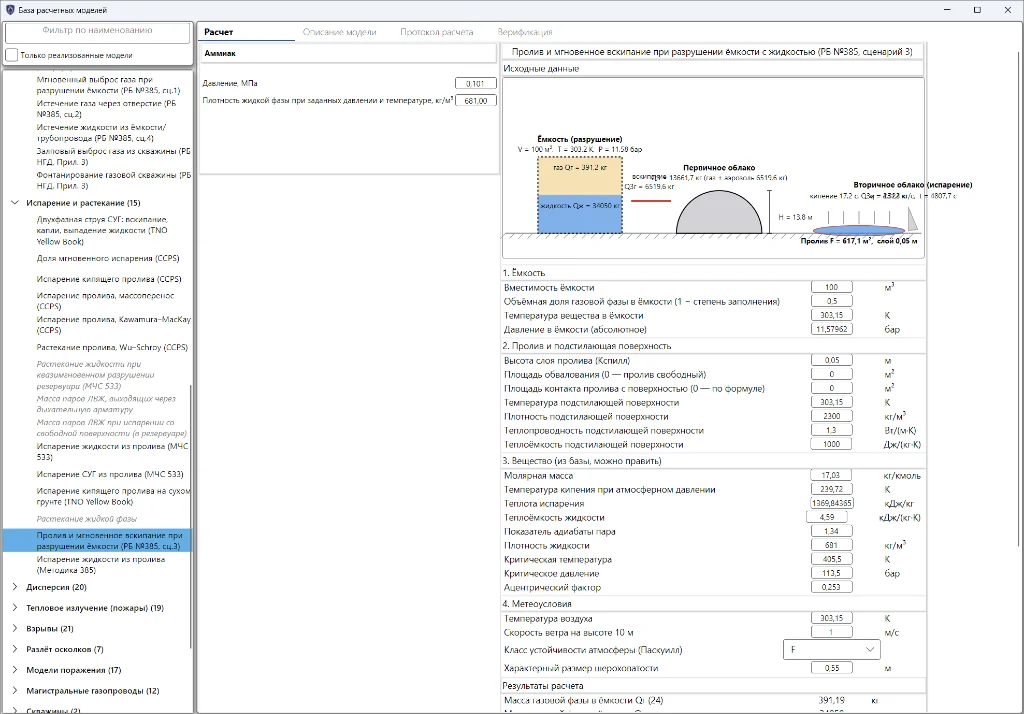
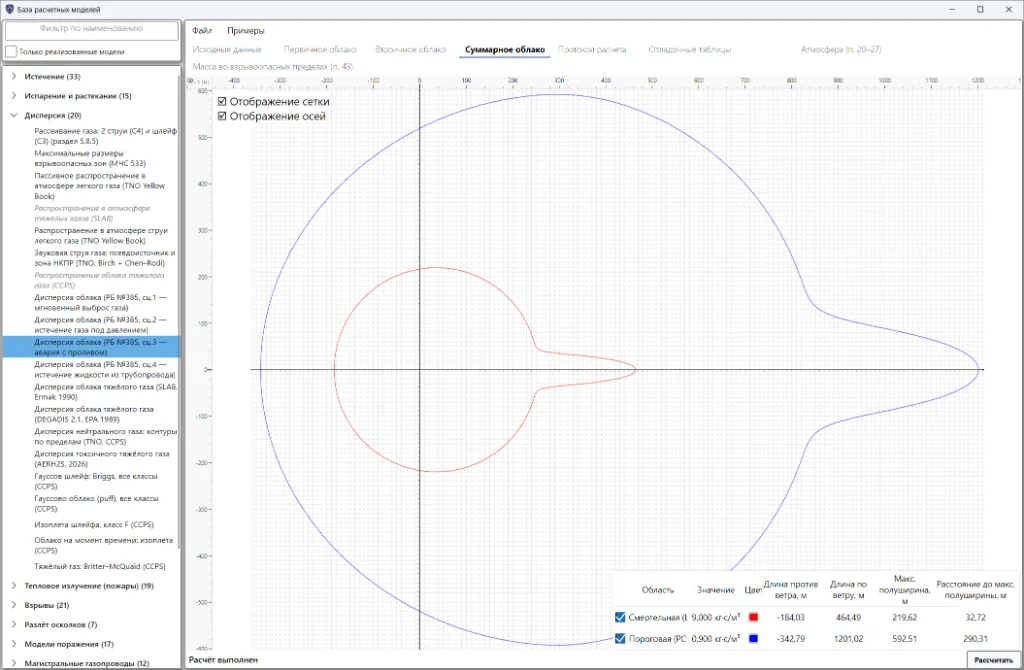
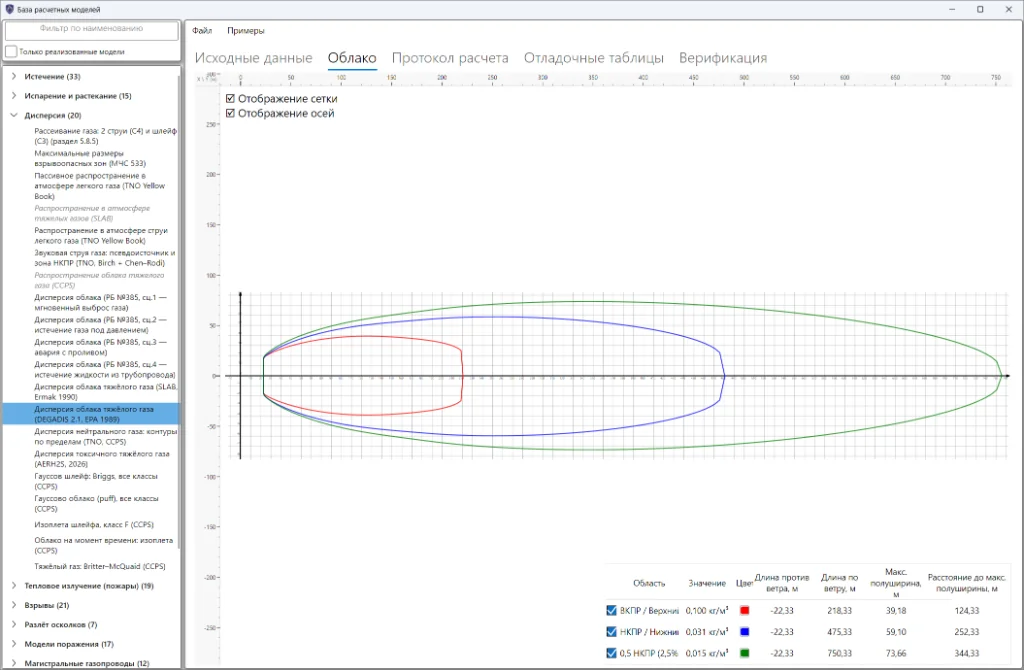
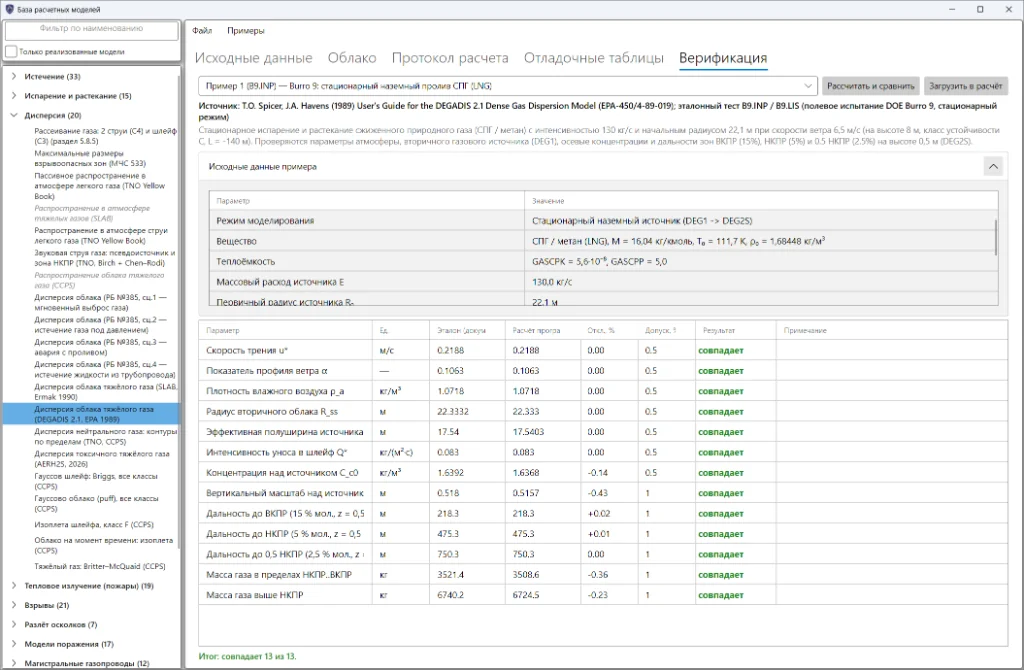
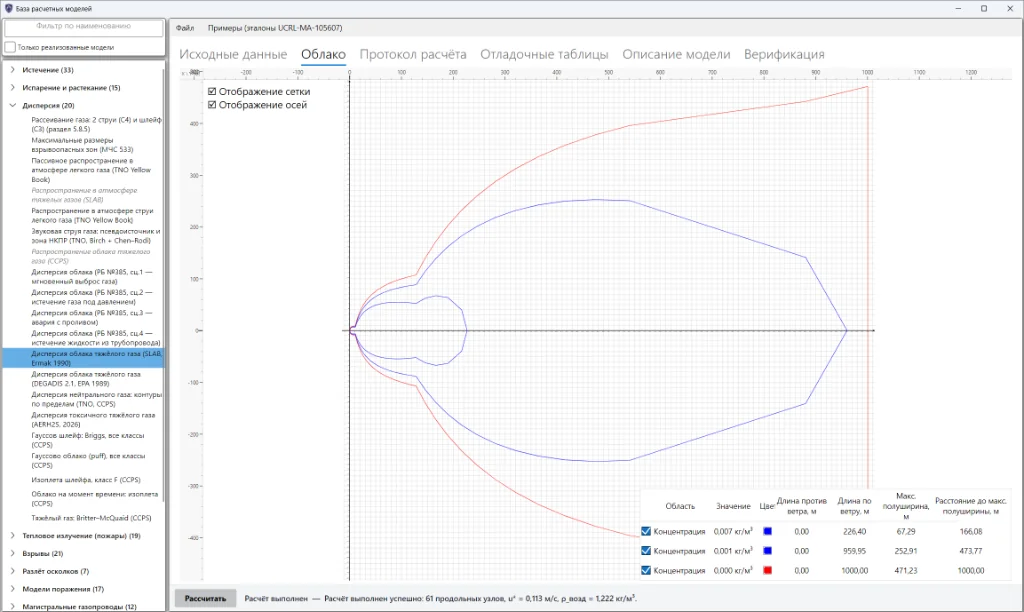
Integrated simulation and verification suite for physical phenomena: from national toxic injury standards (RTH RB 385) to gold-standard 3D heavy gas dispersion codes DEGADIS 2.1 (EPA/USCG) and SLAB (Ermak, LLNL).
Built-in verified library of thermal radiation models (19 models), deflagration and detonation explosions (21 models), and fragment missile throw (7 models) per Gazprom, EMERCOM, Rostekhnadzor, TNO Yellow Book, and CCPS standards.
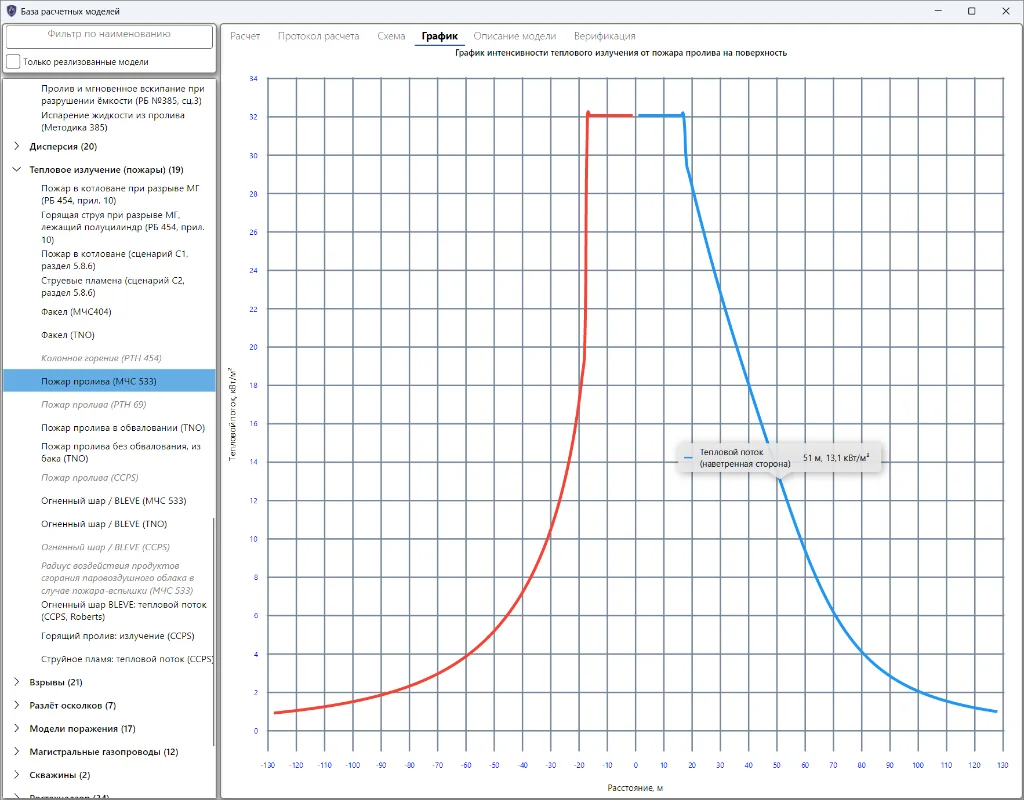
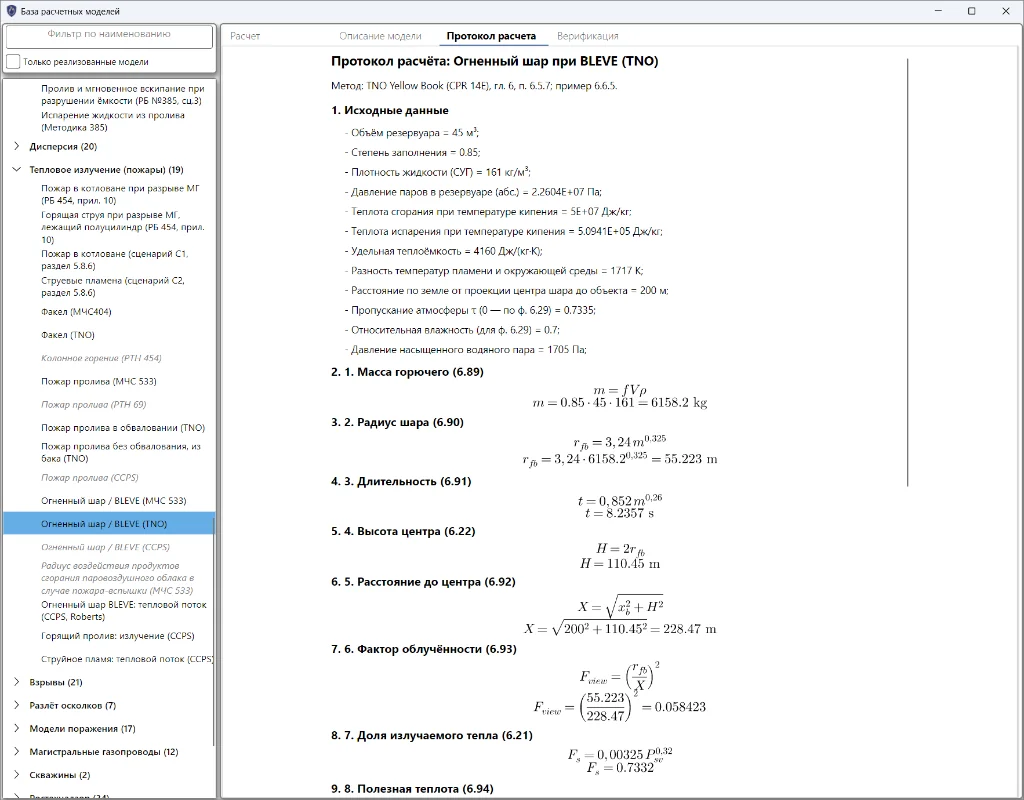
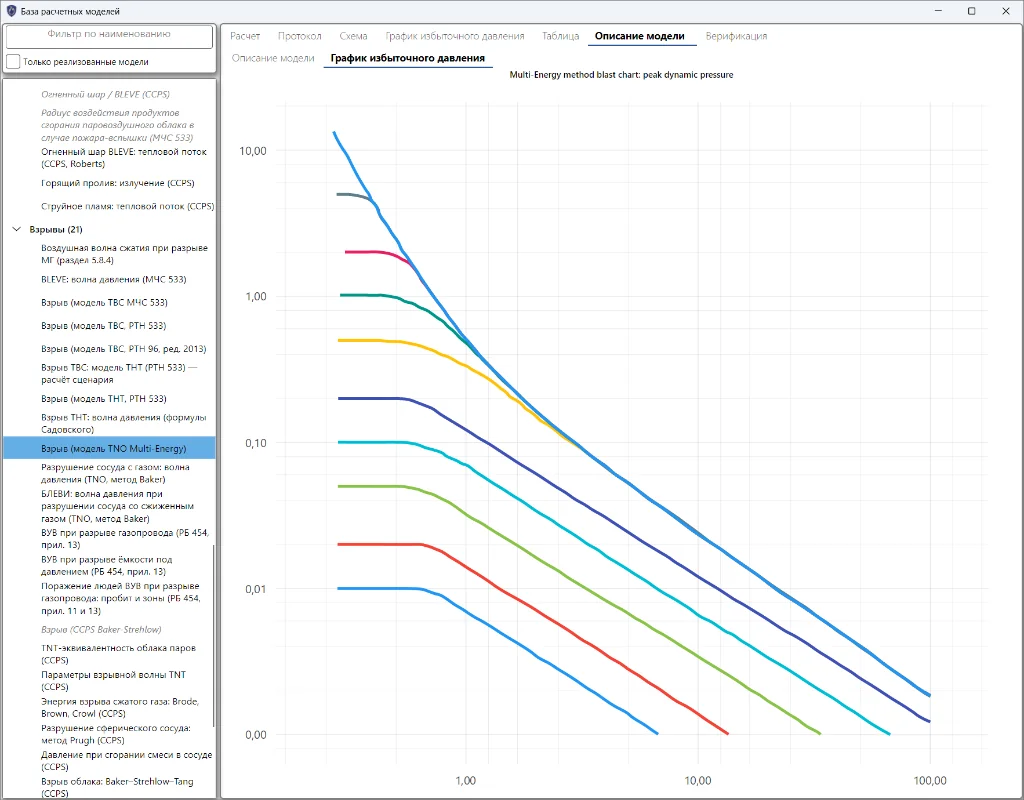
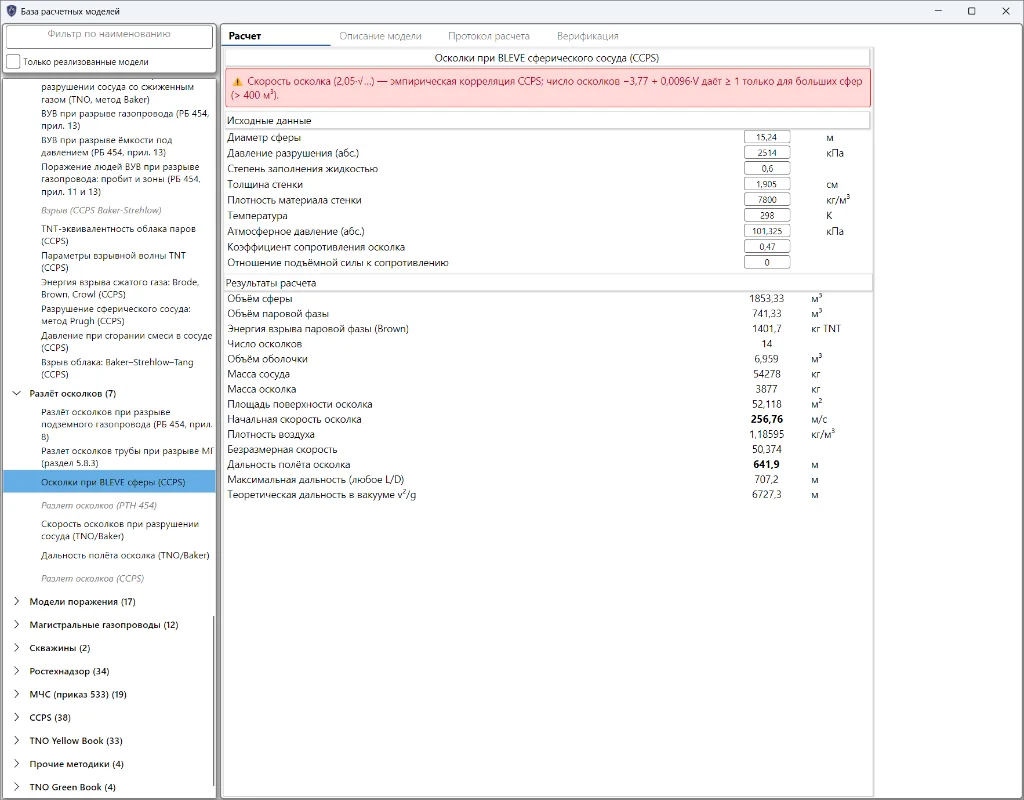
Risk Assessment 1.0 automatically links technological equipment (pressure vessels, pumps, piping, wells, furnaces, road tankers) with verified regulatory event trees from Rostekhnadzor, EMERCOM, and TNO.
Engineers can either utilize standard conditional branch probabilities or configure custom trees with safety instrumented systems (SIS/SIL) and active isolation barriers.
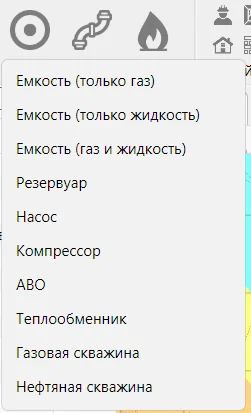
One-click addition of standard process apparatus. When placing an object, the software automatically initializes geometric parameters, regulatory leak frequencies, and dynamic event tree bindings.
Simulation of extended pipeline networks of arbitrary length and routing. Automatic spatial segmentation into computational sections with specific failure rates per kilometer-year (1/(km·yr)).
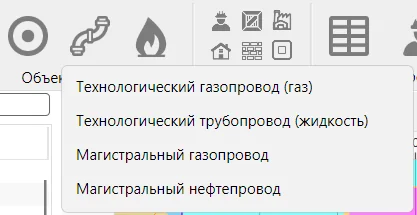
Fast modeling of standalone localized accidental hazards without complete plant inventory modeling — ideal for rapid screening checks, benchmark verification, and auditing.
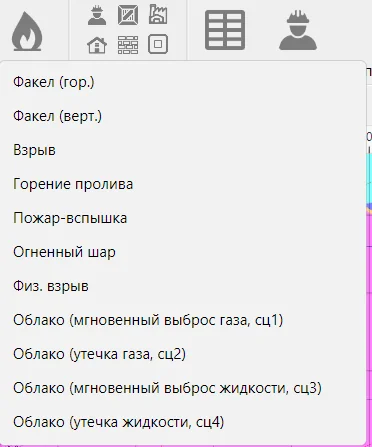
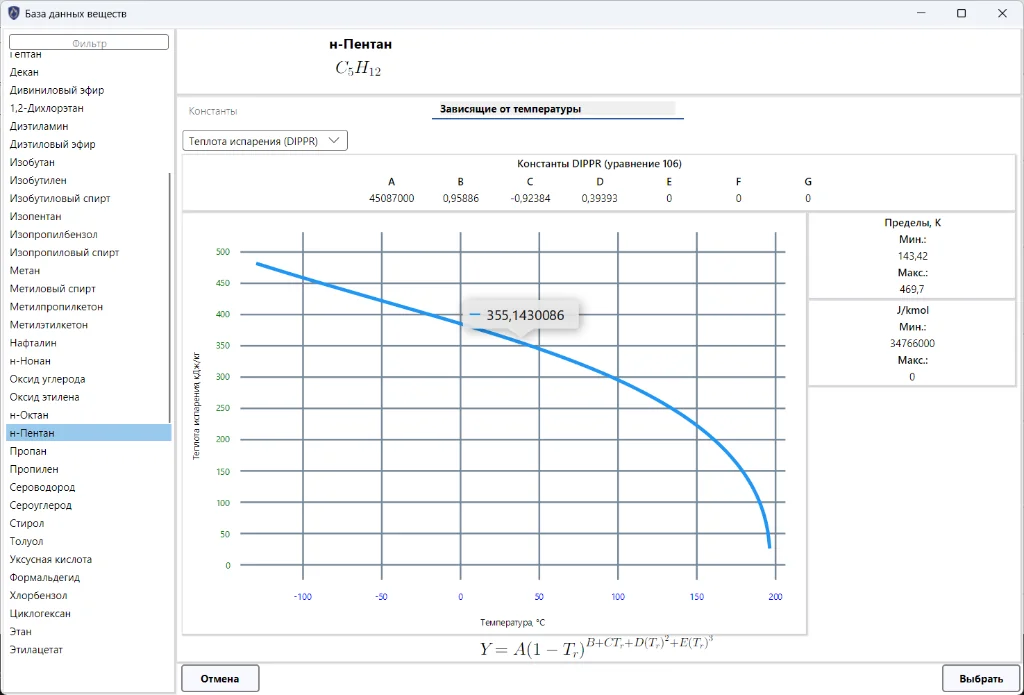
High calculation precision is guaranteed by verified substance properties from official standards, DIPPR® 801 temperature-dependent correlations, and meteorological observation records.
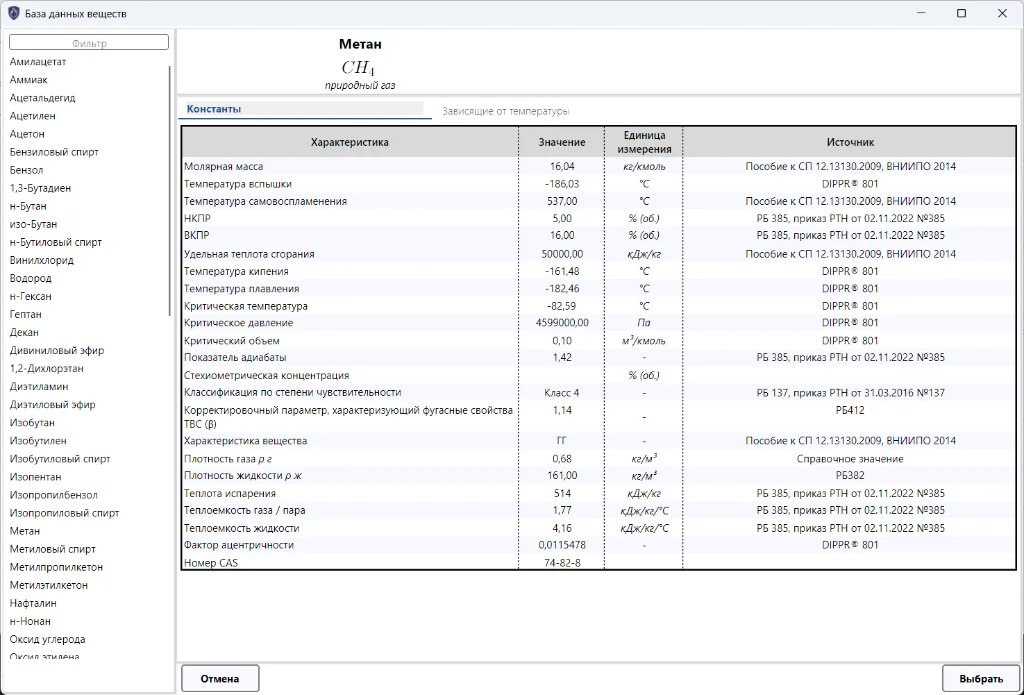
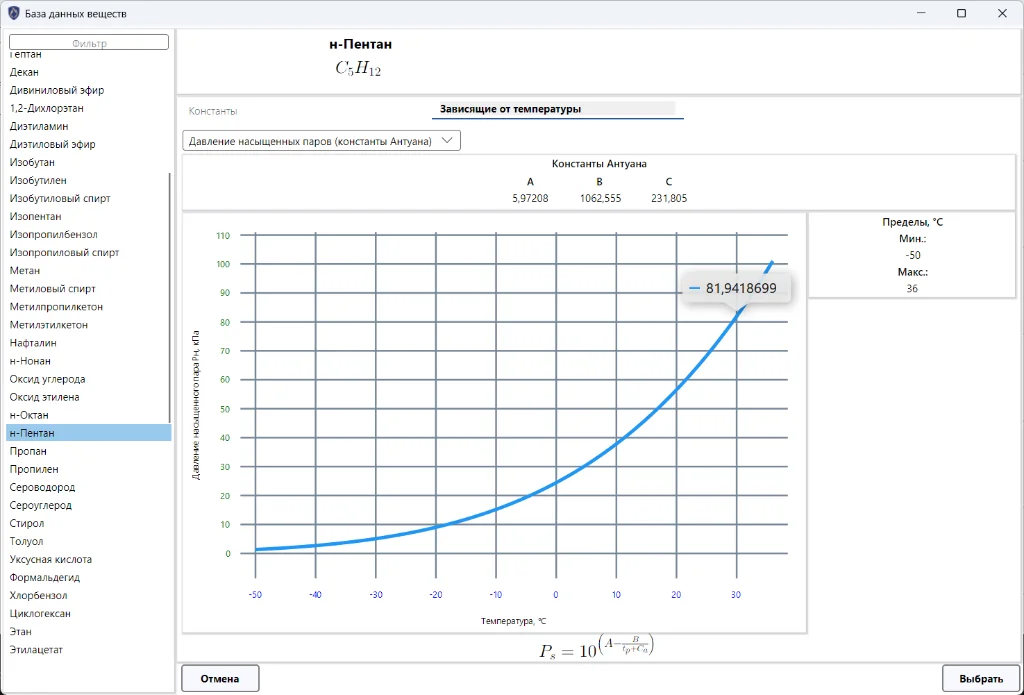
Comprehensive chemical library of physicochemical and explosion properties of hazardous industrial substances (hydrocarbons, LPG, toxic TIC, oil products, crude oil). All values are verified per official regulatory handbooks:
For continuous accident simulation across all temperature ranges (from sub-zero winter temperatures up to operating heat), parameters are computed as analytical temperature functions:
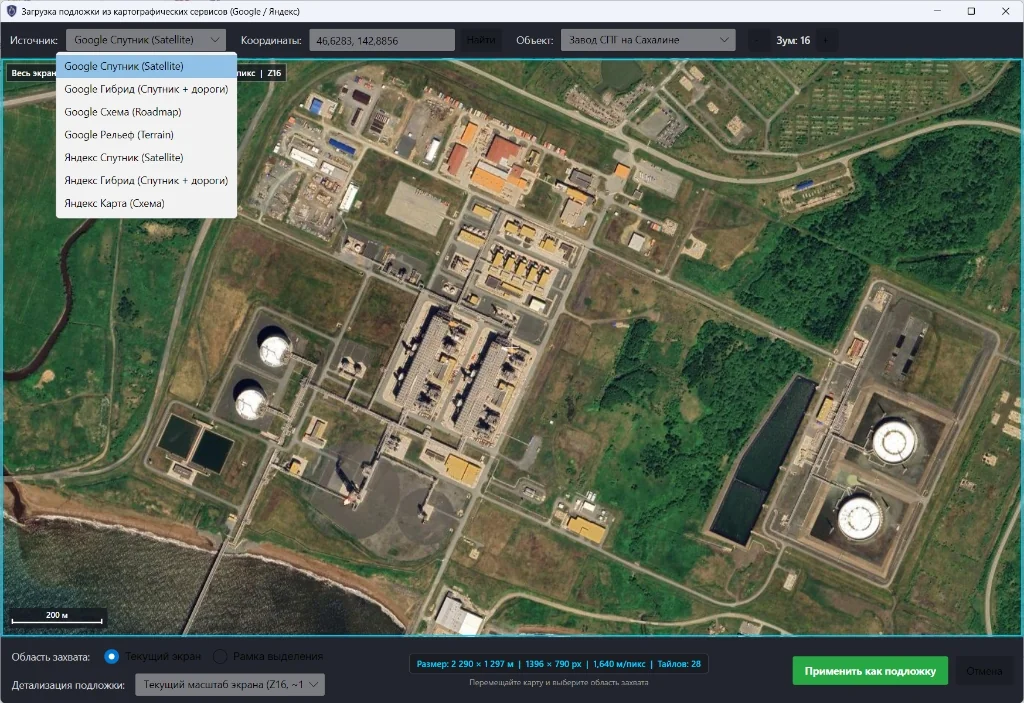
Integrated module for seamless high-resolution satellite basemaps download directly from online providers with automated scale calibration and WGS 84 georeferencing:
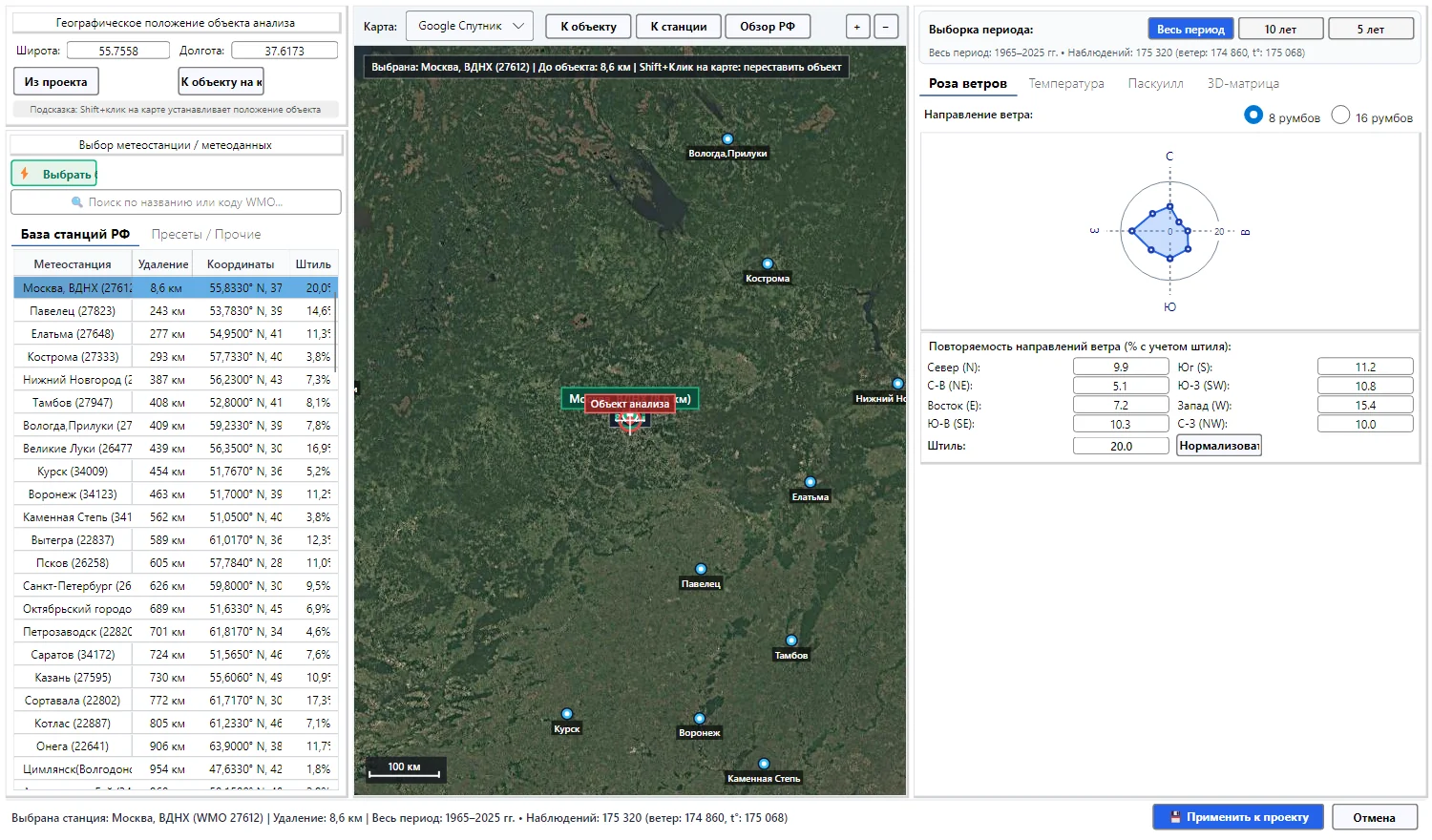
Integrated satellite map and Roshydromet / WMO weather station catalog with long-term climate observation records (over 175,000 synoptic time steps):
Built-in database of verified conditional ignition models with automated computation of immediate ignition, delayed ignition, flash fire, and deflagration VCE shares as functions of mass release rate and physical state.
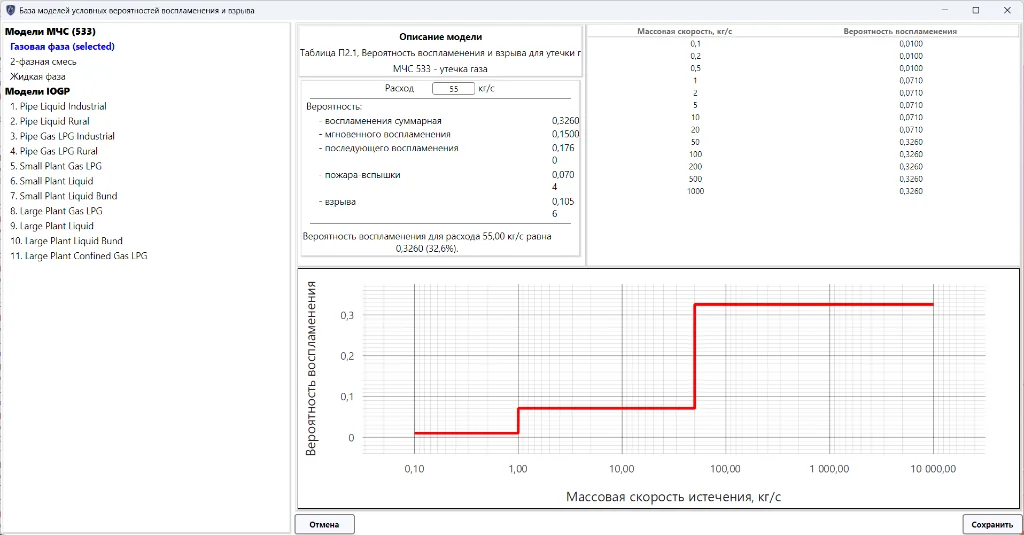
Official stepwise dependencies of ignition and explosion probability on release rate (from 0.1 to 1000 kg/s) for gas, two-phase mixture, and liquid phase.
Automated calculation of total ignition probability, immediate vs. delayed ignition, and conditional split between flash fire and vapor cloud explosion.
Instant evaluation of probabilities for user-entered mass release rate (kg/s), interactive logarithmic chart, and reference value matrix.
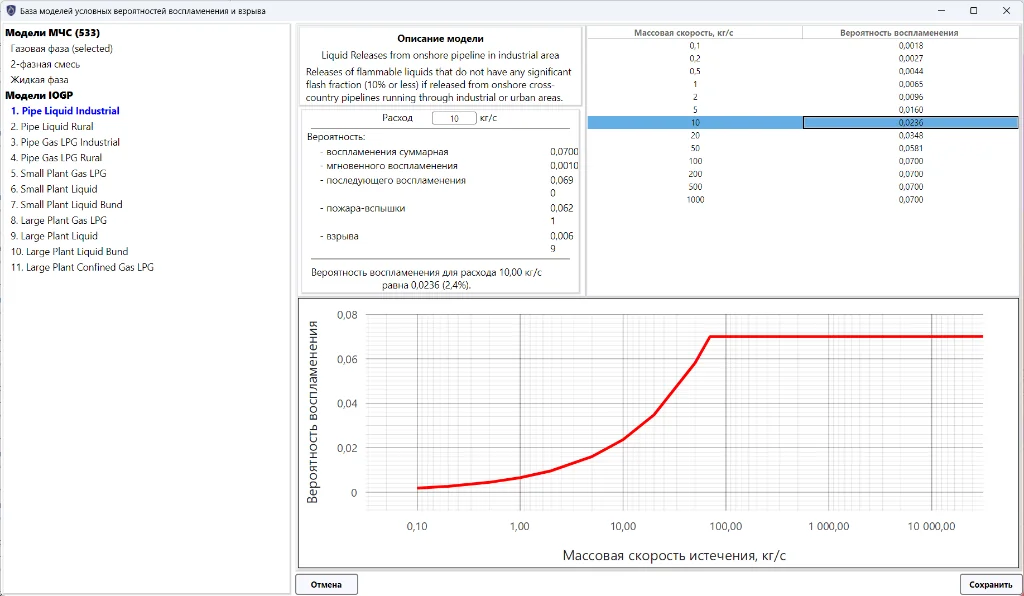
Categorization by facility category: cross-country & gathering pipelines (Industrial/Rural, Gas/Liquid), small and large process facilities (Small/Large Plant, Liquid Bund, Confined Gas).
Mathematically continuous sigmoid curves spanning discharge rates from 0.1 to 10,000+ kg/s, eliminating artificial probability jumps when interpolating hole diameters.
Full adherence to International Association of Oil & Gas Producers guidelines for offshore platforms, FPSOs, LNG liquefaction/regasification facilities, and refineries.
Accurate evaluation of individual and societal risk (FN/FG curves) requires strict modeling of staff headcount, shift schedules, and actual dwell times in buildings and outdoor process areas.
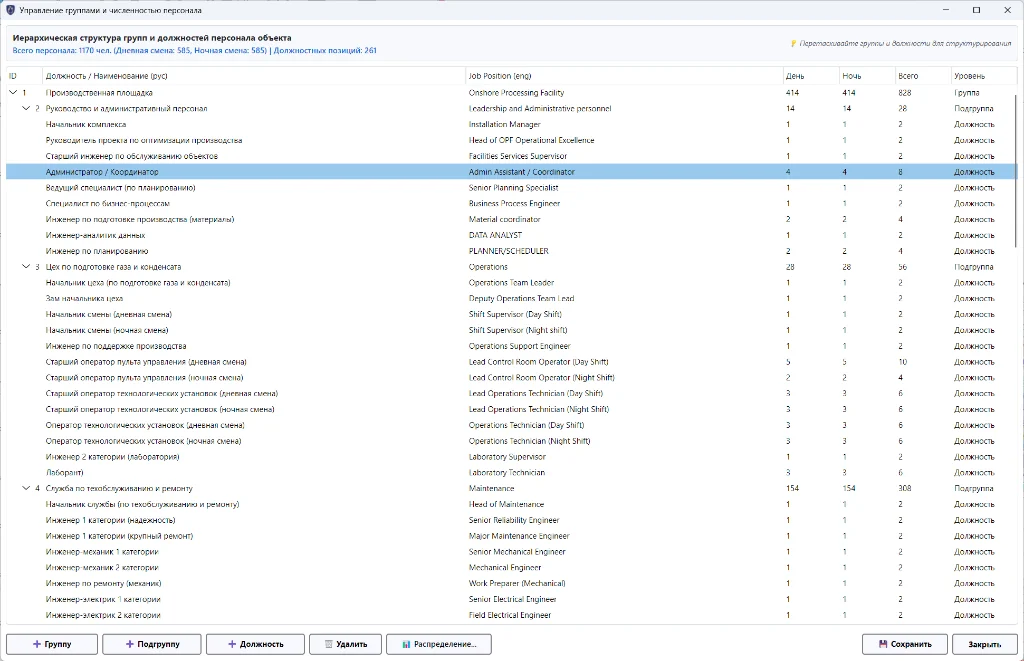
Tree structure ranging from whole facility down to individual process units, departments, and job titles with Drag-and-Drop grouping support.
Independent headcount tracking for day and night operating shifts, with automated roll-up headcount aggregation across departments.
Synchronized Russian and English job title naming for seamless inclusion into international QRA engineering deliverables.
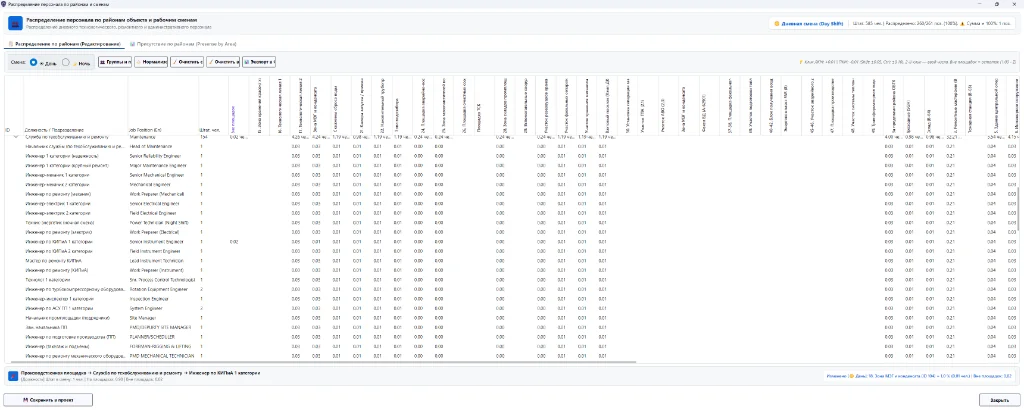
Matrix mapping each employee's presence across central control rooms, workshops, pump houses, pipe racks, offices, and outdoor units.
Built-in mathematical validation of shift duration (sum strictly equals 100% / 1.00) with automatic tracking of off-site presence.
Seamless integration of presence factors with hazard contours (overpressure, thermal flux, toxic doses) to generate FN curves per regulatory standards.
Risk Assessment 1.0 computes and renders high-resolution integral risk contours, flammable gas cloud frequencies, and hazard factor exposure maps with customizable threshold criteria and wind rose interpolation.
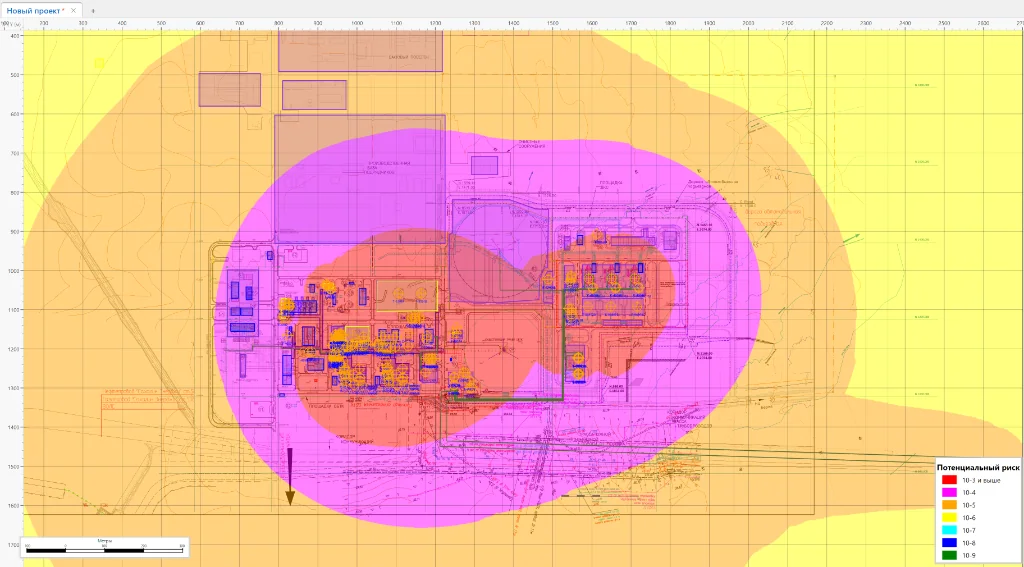
Integration of risk contributions from hundreds of accidental scenarios (loss of containment in vessels, units, pumps, pipelines) across the computational grid.
Differentiated color scale for hypothetical recipient fatality frequency: from background 10⁻⁹–10⁻⁷ yr⁻¹ up to critical zones 10⁻⁴ and ≥10⁻³ yr⁻¹.
Engineering justification of buffer zones, safe separation distances to residential settlements, neighboring industrial plants, and transport routes.
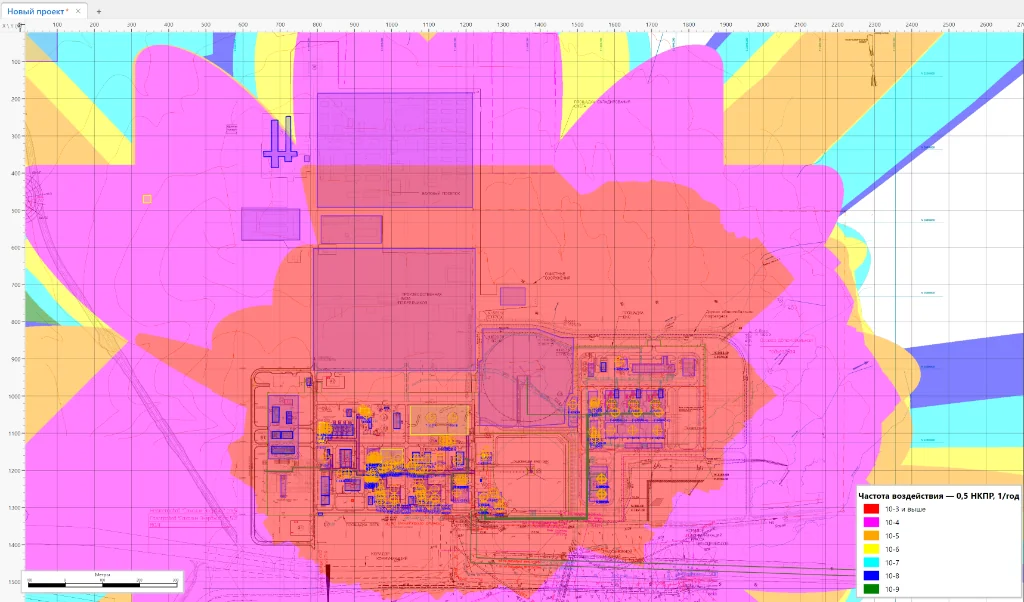
Calculation of cumulative recurrence frequencies of flammable concentrations (0.5 LFL, LFL, UFL) at any plot location considering weather statistics.
Generation of radial and smoothly interpolated vapor cloud dispersion fields across 8–64 compass sectors linked to synoptic weather station data.
Quantitative optimization of stationary flammable and toxic gas detection layouts (FGS design) grounded in frequency contour fields.
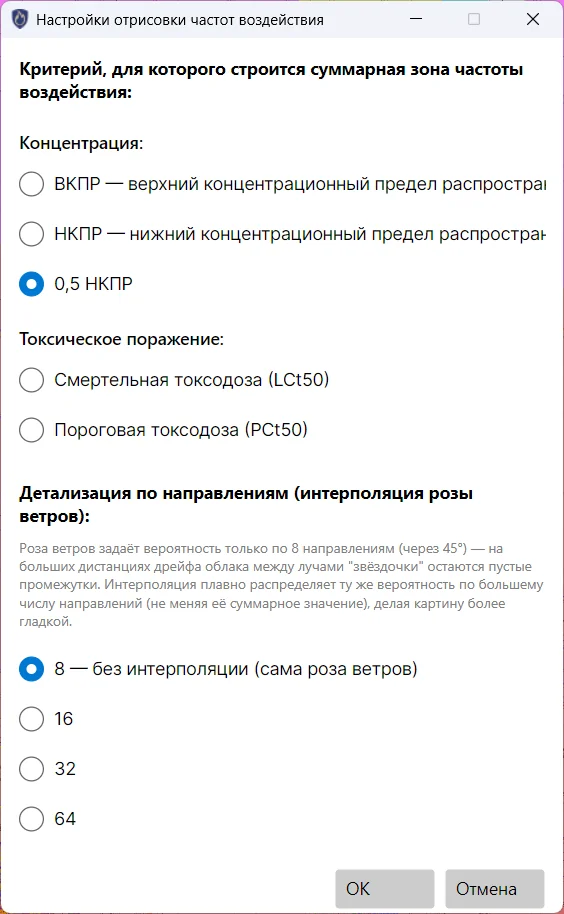
Flammability limits: UFL, LFL, or 0.5 LFL (regulatory lower explosive limit threshold).
Toxic injury: lethal toxic load (LCt50) or threshold toxic load (PCt50).
Meteorological wind roses often define wind probabilities across 8 compass points (at 45° increments). Cloud drift over extended distances can leave sector gaps between rays. The software smoothly interpolates wind rose probabilities into 16, 32, or 64 directions while preserving total sector probability, producing smooth and realistic frequency contours.
Switching threshold criteria recalculates and redraws contour isolines instantly in real time without having to re-run heavy thermal and hydraulic simulations.
Justification of blast resistance of industrial buildings and structures in accordance with Federal Safety Regulations (FNP No. 533 approved by Rostekhnadzor on Dec 15, 2020) and Safety Guide "Methods for Justifying Blast Resistance of Buildings and Structures in Fuel-Air Explosions at Hazardous Industrial Facilities" (approved by Rostekhnadzor Order No. 413 on Nov 28, 2022).
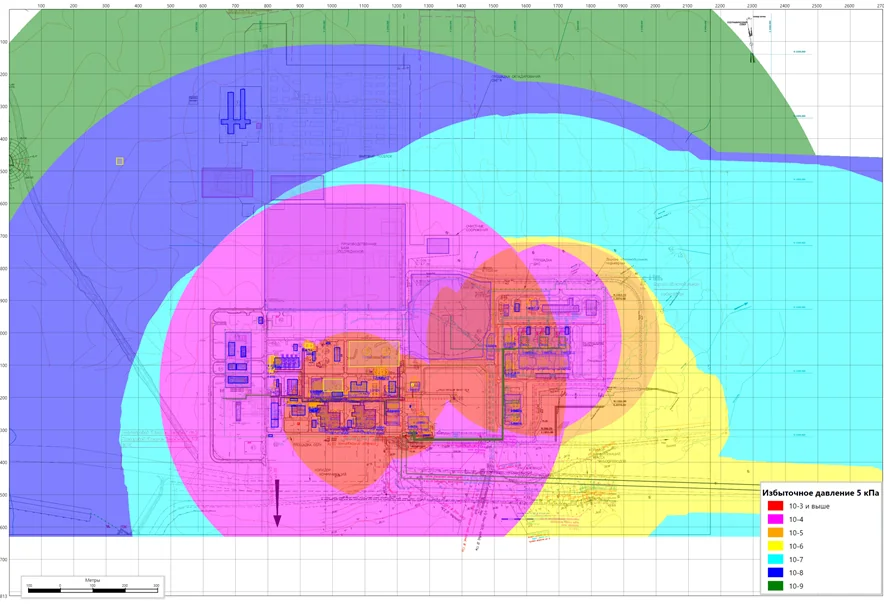
Lower limit of light damage to warehouses according to Safety Guide No. 413 (Rostekhnadzor Order of Nov 28, 2022). Evaluation of impact zones on lightweight warehouse and auxiliary structures.
Maximum radius of overpressure frequency exposure covering peripheral storage areas, auxiliary buildings, and plant boundary fence lines.
Color differentiation of exceedance frequency isolines from background 10⁻⁹ yr⁻¹ up to hazardous process zones ≥10⁻³ yr⁻¹ mapped directly to the site layout.
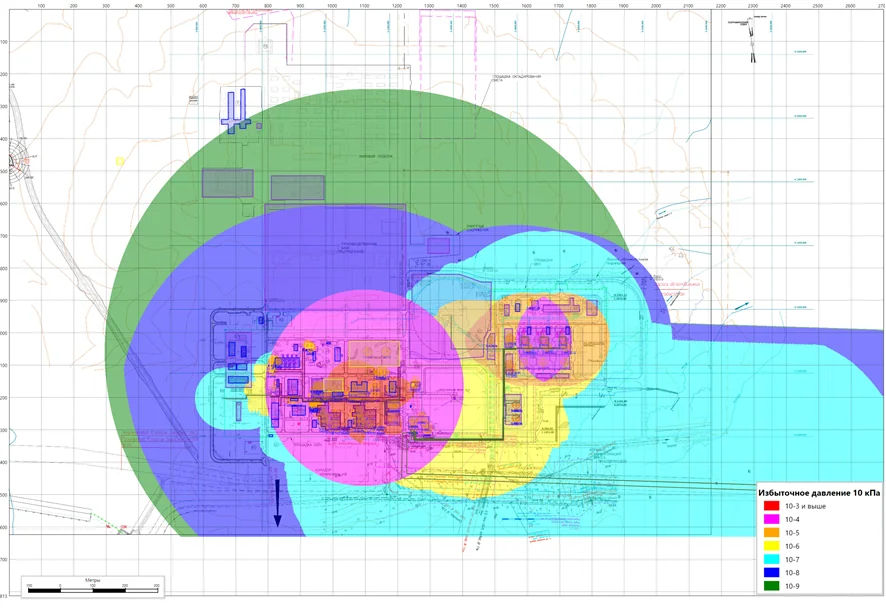
Lower limit of light damage to brick and light industrial buildings (Safety Guide No. 413). Inception of structural distortion in roofing, sandwich cladding panels, and interior partitions.
Concentration of hazardous overpressure isolines within site boundaries, clearly localized relative to oil and gas processing units.
Calculation of design exceedance frequency to justify reinforcement requirements for structural elements of production and auxiliary buildings.
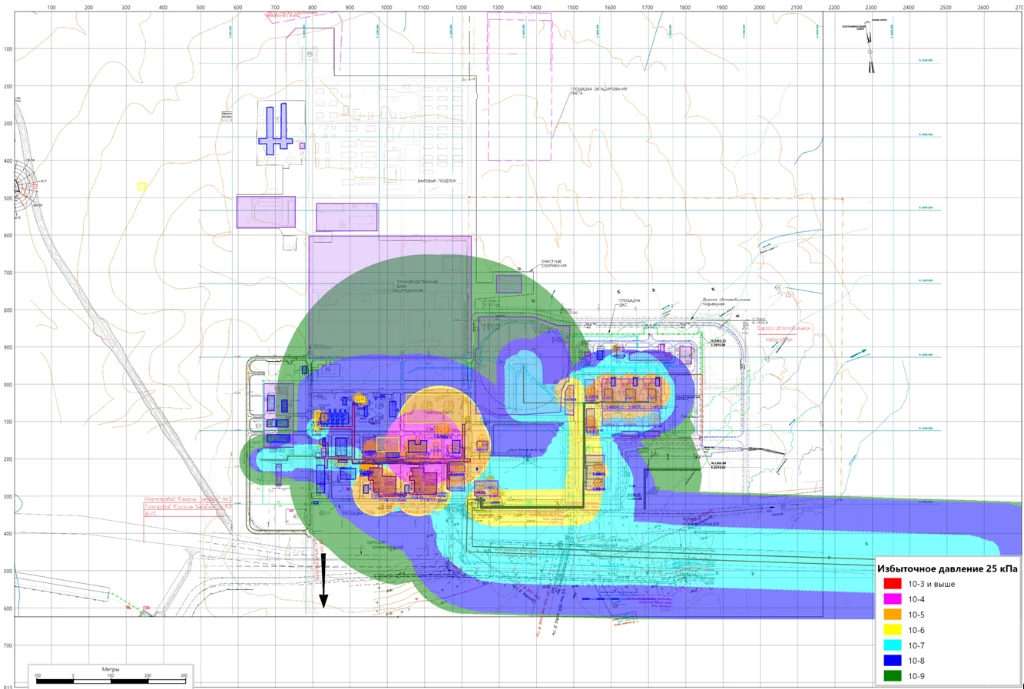
Lower limit of damage to concrete and reinforced concrete buildings, moderate damage to brick and light industrial buildings per Safety Guide No. 413 and FNP No. 533.
Key regulatory calculation for central control rooms (CCR), operator shelters, electrical substations, and continuously manned facilities. Verification of critical load recurrence frequencies.
Quantitative verification of control room blast resistance, ensuring explosion safety compliance and safeguarding operating personnel at hazardous industrial sites.
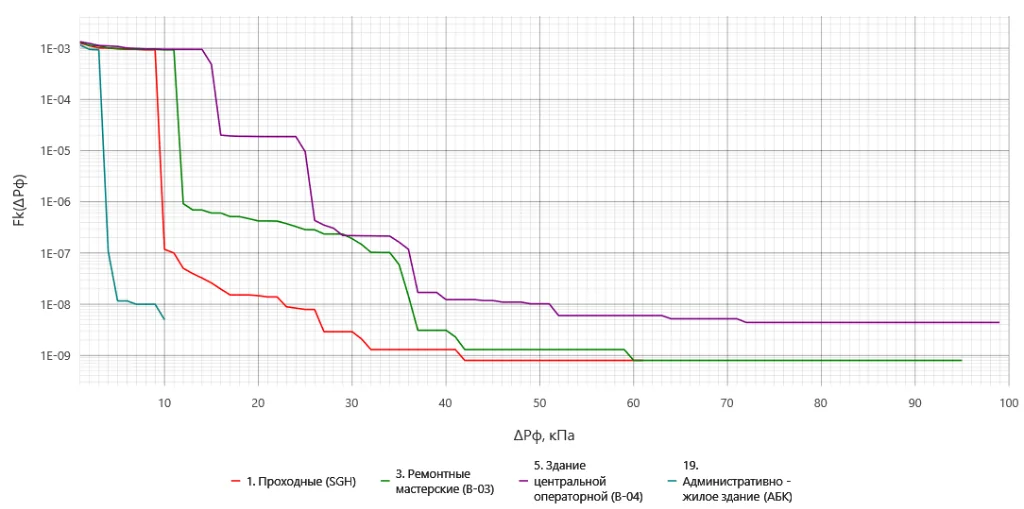
Generation of individual curves for each facility structure: 1. Security Gatehouse (SGH), 3. Maintenance Workshop (B-03), 5. Central Control Building (B-04), 19. Administrative Complex.
Continuous spectrum of blast pressures ΔP from 1 to 100 kPa with logarithmic frequency scale from 10⁻³ to 10⁻⁹ yr⁻¹ to substantiate civil engineering design.
Automated export of charts and tables for Emergency Preparedness & Civil Defense (EPCD) engineering chapters and Facility Industrial Safety Declarations.
Risk Assessment 1.0 renders high-definition vector and raster isolines of hazard factor footprints overlaid directly onto the topographical site plan.
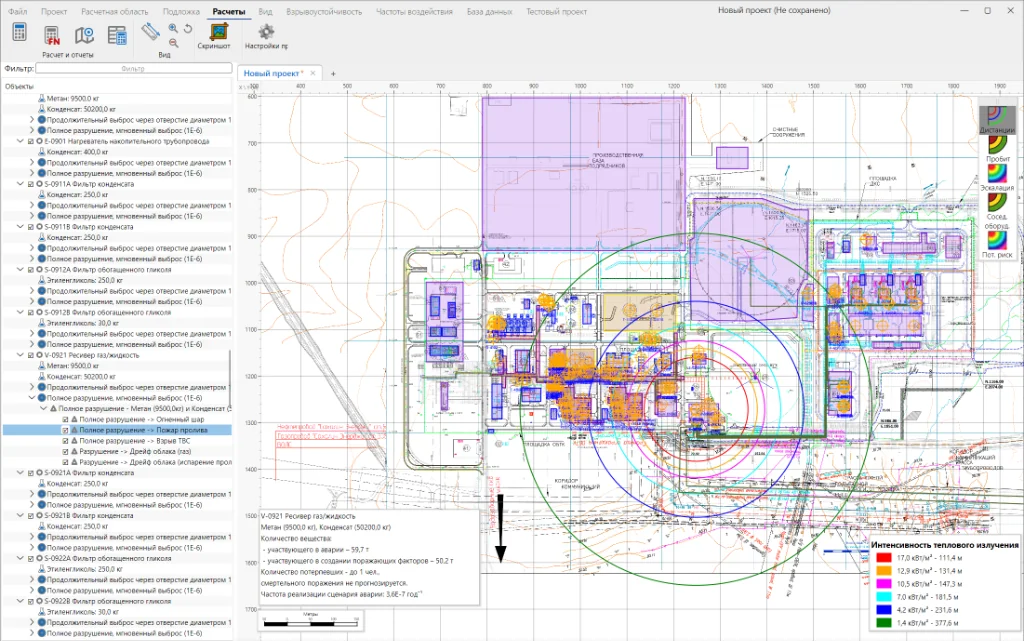
Generation of vector isolines for thermal radiation (1.4, 4.2, 7.0, 10.5, 12.9, 17.0 kW/m²), VCE blast overpressures (3, 5, 12, 28, 53, 100 kPa), and toxic inhalation doses.
Dynamic interactive legend computing exact damage threshold radii in meters for every accident scenario and severity level.
Overlay of consequence zones onto process layouts, buildings, and property boundaries to monitor off-site hazard footprints.
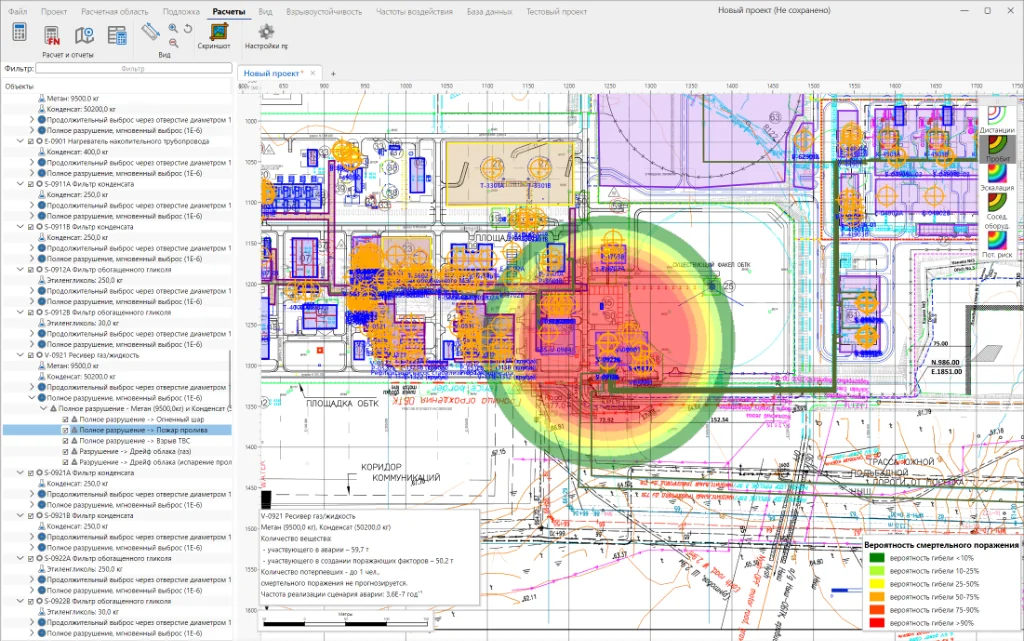
Calculation of human fatality probabilities per Rostekhnadzor and EMERCOM standards accounting for exposure duration, radiative flux, and peak blast overpressure.
Delineation of lethality brackets: <10%, 10–25%, 25–50%, 50–75%, 75–90%, and >90% for unambiguous identification of high-risk operational zones.
Automated calculation of expected numbers of injuries and fatalities (individual to mass casualty events) displayed in the scenario summary passport.
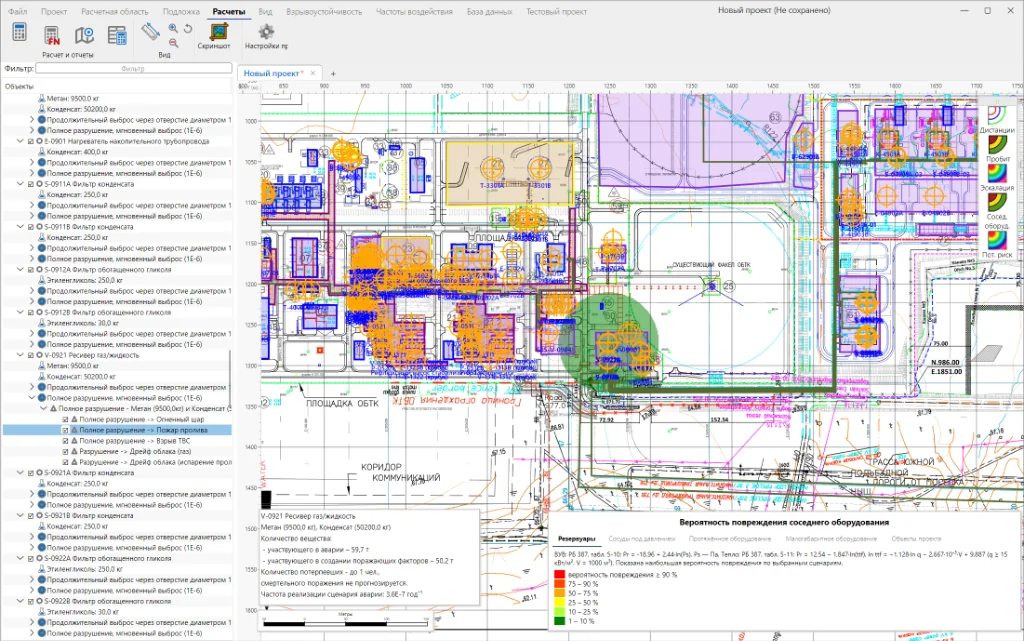
Mathematical vulnerability models for damage to adjacent storage tanks, pressure vessels, and piping per Rostekhnadzor Orders No. 387 (Tables 5-10, 5-11) and 414.
Targeted resilience assessment for atmospheric tanks, pressure vessels, elongated and compact apparatus with color-coded damage risk brackets (1–10% to ≥90%).
Identification of vulnerable process assets to provide engineering justification for deluge water spray systems, blast walls, and passive fireproofing coatings.
Expand 🔍
Isolines of physical damage thresholds (thermal flux, blast wave) with distance calculation in meters.
Expand 🔍
Spatial distribution of human lethality probabilities based on verified probit functions.
Expand 🔍
Damage probability evaluation for neighboring storage vessels to simulate cascade escalation.
Expand 🔍
Cumulative potential territorial risk contours rendered over the facility layout.
Expand 🔍
Cumulative frequencies of flammable concentrations (0.5 LFL) and toxic doses across compass points.
Expand 🔍
Frequency exceedance curves of structural overpressure loading for blast-resistance verification.
Expand 🔍
Selection of damage criteria and wind rose smoothing for seamless dispersion contouring.
Expand 🔍
Global switching of methodology packages (EMERCOM / RTH / TNO / CCPS) across all project assets.
Expand 🔍
Statistical release frequency matrices and dynamic event tree bindings by equipment type.
Expand 🔍
Modern CAD-style GUI, Ribbon toolbar, scenario filtering, and multi-layer basemap control.
Expand 🔍
Ribbon control bar, process equipment tree, and calculation domain in Russian.
Expand 🔍
English Ribbon toolbar, calculation domain, and quantitative risk assessment tools for international audits.
Expand 🔍
Regulatory logical failure tree for pressurized vessels with gas and liquid inventories.
Expand 🔍
Unstable liquid pipelines branching into vertical/horizontal jet flames and VCE clouds.
Expand 🔍
Rupture of gas transmission pipeline DN 1420 mm branching into thermal and blast outcomes.
Expand 🔍
Direct high-res imagery download from Google and Yandex with automated coordinate alignment.
Expand 🔍
Workforce categorization into departments, units, and job positions accounting for shift patterns.
Expand 🔍
Detailed spatial assignment of staff presence across buildings and plots for risk evaluation.
Expand 🔍
Stepwise probability models per Table P2.1 for vapor, liquid, and two-phase releases.
Expand 🔍
11 process and pipeline models with continuous S-curves covering 0.1 to 10,000 kg/s.
Expand 🔍
Computation of lethal and threshold toxic doses during pool evaporation per RTH Scenarios 1–4.
Expand 🔍
EPA/USCG heavy gas code: LFL/UFL flammable contours accounting for gravity slumping.
Expand 🔍
Automated validation against DOE field test: 100% consistency with analytical benchmark.
Expand 🔍
Numerical atmospheric dispersion modeling of dense vapor plume with two-phase effects.
Expand 🔍
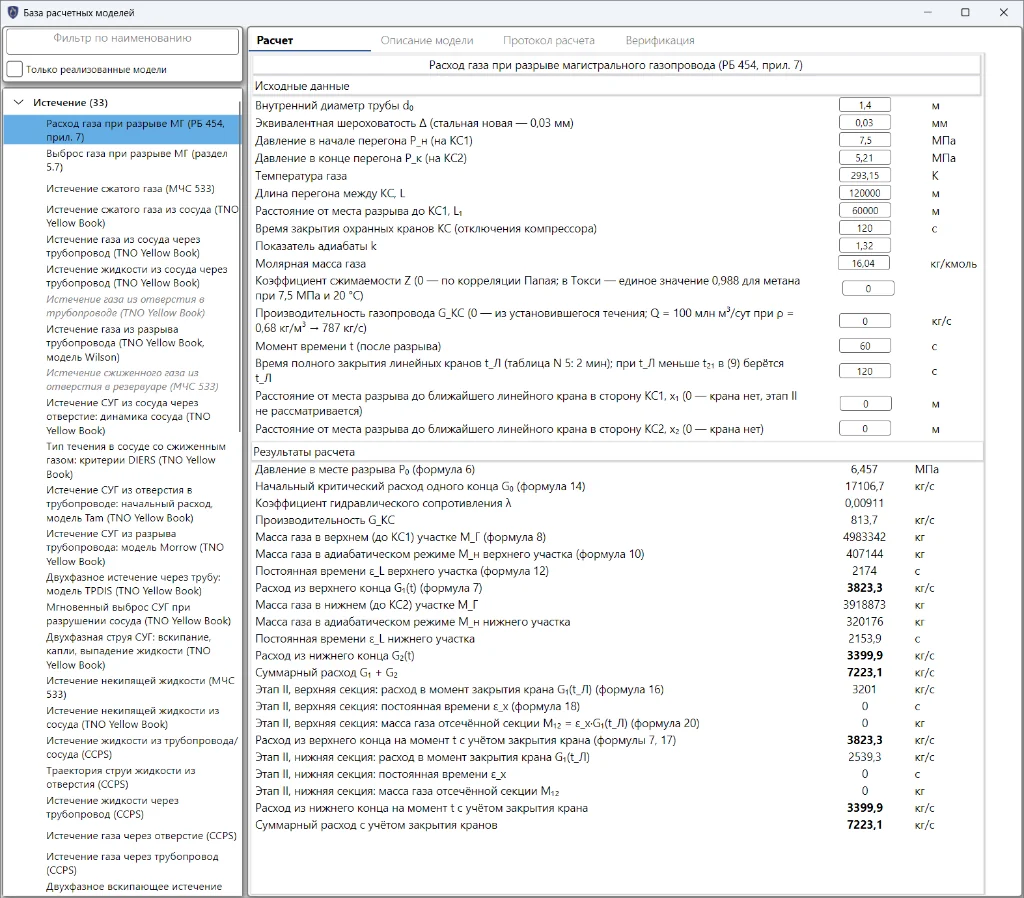
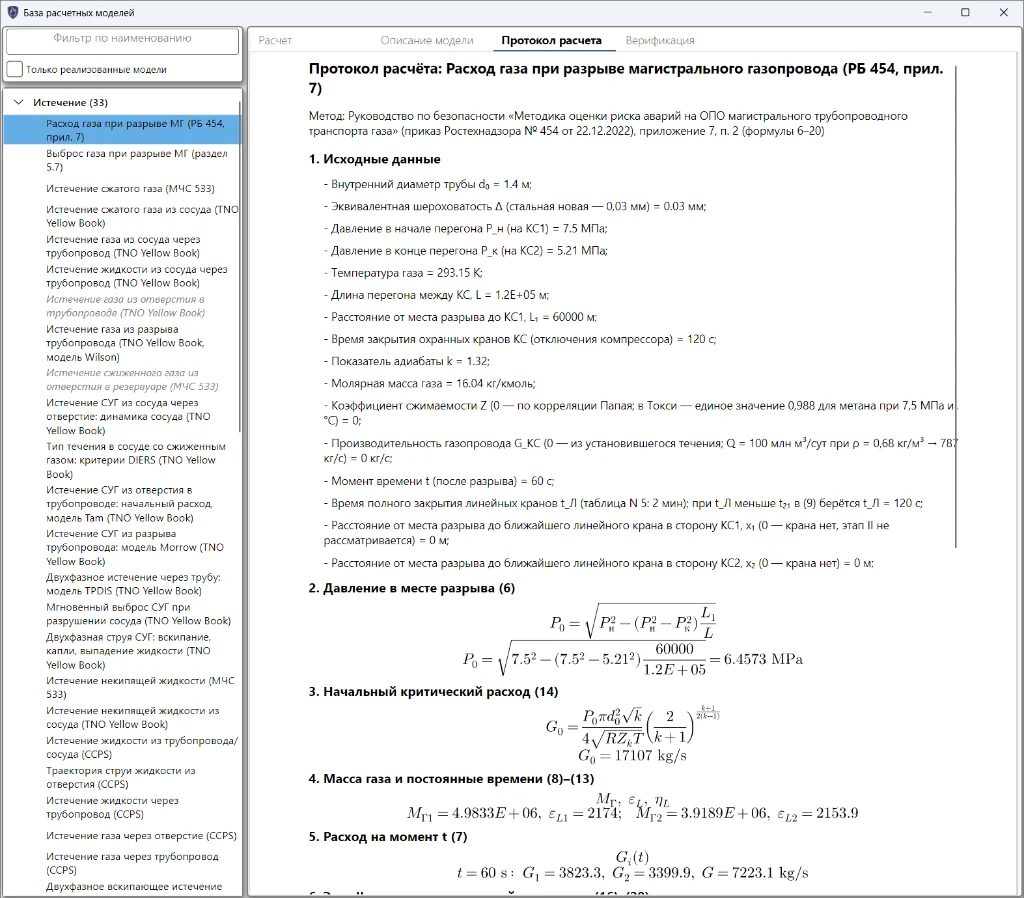
Transient choked gas discharge from large-diameter pipe with automatic emergency valve shut-off.
Expand 🔍
Formal mathematical calculation protocol complying with Appendix 7 of RTH Order No. 454.
Expand 🔍
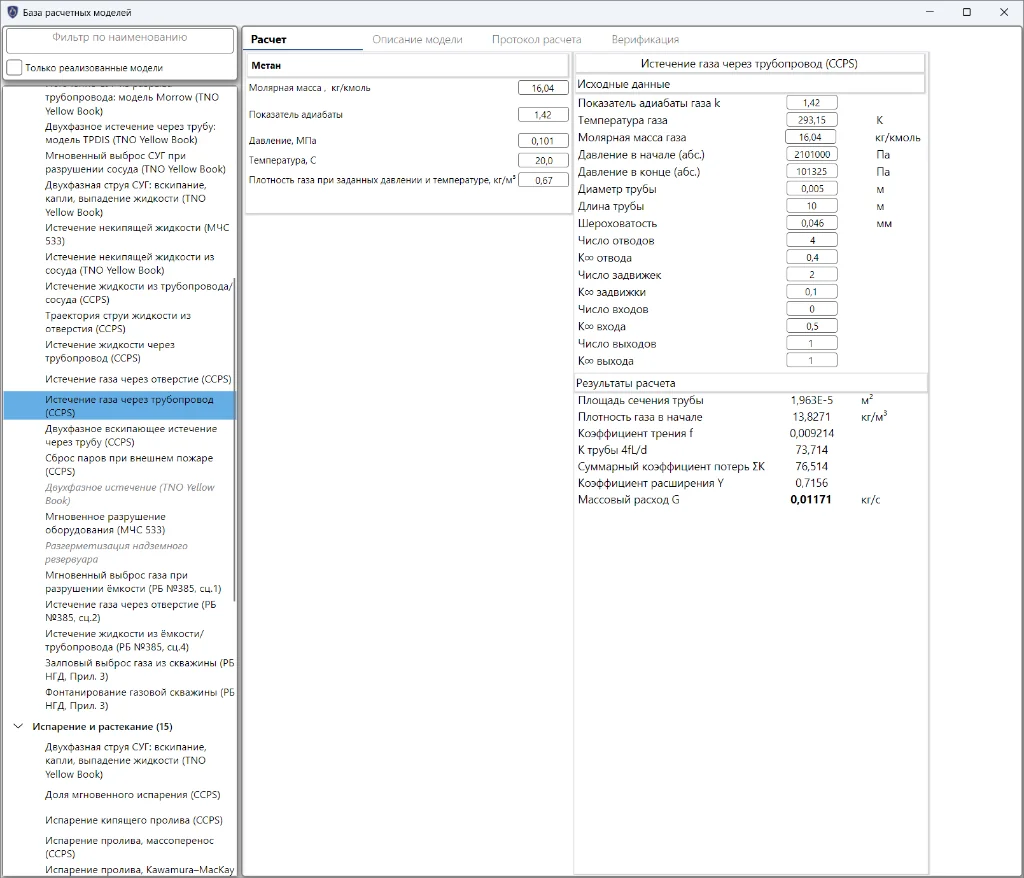
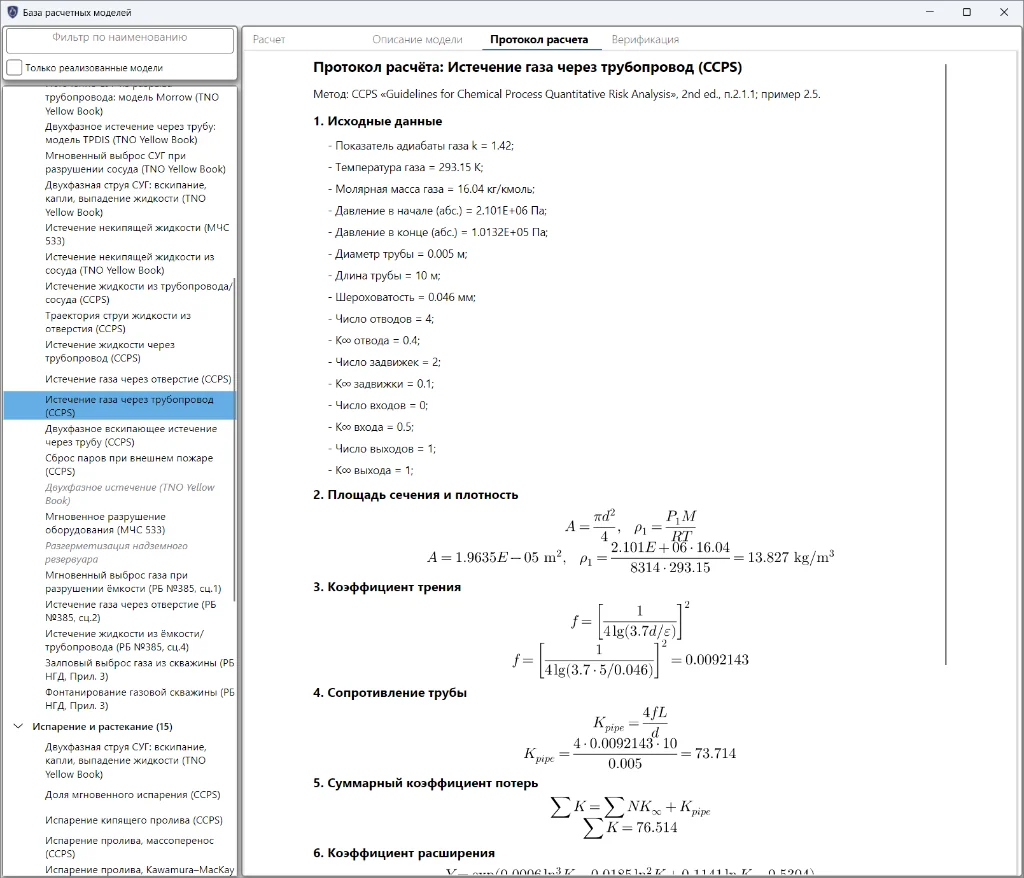
Simulation per international CCPS Guidelines with explicit fitting loss coefficients.
Expand 🔍
Simulation of reservoir inflow and unconstrained discharge through telescopic casing profile.
Expand 🔍
Physical model of pressurized vessel burst, aerosol droplet entrainment, and liquid pool.
Expand 🔍
Formal analytical calculation protocol adhering to Rostekhnadzor Safety Guide No. 385.
Expand 🔍
Scenario C2 per STO 351: supersonic ignited gas jet with thermal lethality zones.
Expand 🔍
Two-sided radiation profile for tilted flame cylinder under crosswind conditions.
Expand 🔍
Formal calculation protocol based on TNO Yellow Book CPR 14E methodology.
Expand 🔍
Differentiated VCE deflagration blast modeling across 10 obstacle congestion classes.
Expand 🔍
Ballistic trajectory simulation of vessel fragments with atmospheric aerodynamic drag.
Expand 🔍
Official computer software registration with the Federal Service for Intellectual Property.
Enterprise licensing suite supporting concurrent floating network seats, workstation-bound node-locks, and air-gapped offline operation.
Ideal for engineering institutes, safety consulting firms, and corporate industrial safety departments.
Cryptographically bound to the hardware profile (HWID) of an individual engineer's computer.
For evaluation, algorithm testing, and executing benchmark verification calculations.
The installer is provided to customers with an active license. The program checks for updates itself: “About” → “Check for updates”.
Information is temporarily unavailable.
Compare the file hash (Get-FileHash <file> -Algorithm SHA256) with the value shown here or with the message from support.
A beta version may be unstable; use it on test projects only.
Information is temporarily unavailable.
Compare the file hash (Get-FileHash <file> -Algorithm SHA256) with the value shown here or with the message from support.
To request an evaluation build of Risk Assessment 1.0, test license credentials, commercial pricing proposals, or expert consulting, contact our engineering team directly.
Send an email inquiry for software distribution packages, evaluation license keys, or commercial proposals directly to our official inbox, or speak directly with our engineers by phone:
